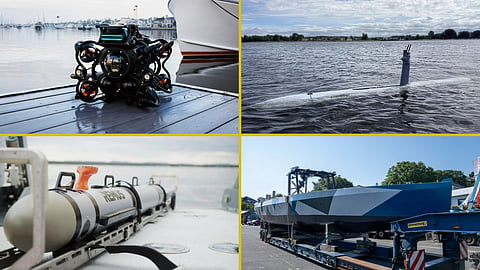


A UK firm has completed construction of a long-range USV while new ROVs have been delivered to the New Zealand Customs Service. New UUVs are under development for US military use. Lastly, a German company has completed conducting a series of trials on a new torpedo tube-launched USV.
Kongsberg and Oceaneering International have been selected by the US Department of War’s Defense Innovation Unit (DIU) to support its combat autonomous maritime platform (CAMP) program, which is focused on the development of extra-large unmanned undersea vehicles (XLUUVs) for future US Navy missions.
The CAMP program will accelerate the transition of mature commercial and defence technologies into operational naval capabilities. Kongsberg said this collaboration will focus on concept definition, system architecture, and design trade studies, emphasising modularity, interoperability, and rapid integration.
Kongsberg and Oceaneering expect their XLUUV design to be delivered in the third quarter of this year.
Submarine systems provider Gabler and German defence technology company FLANQ have completed conducting the sea acceptance tests (SAT) of a new unmanned surface vehicle (USV) designed to be launched via torpedo tube.
The demonstrator USV, named Ranger, was designed to be launched from a standard 21-inch submarine torpedo tube and then autonomously surface and undertake cover intelligence, surveillance and reconnaissance missions. The 4.5-metre platform features a folding keel and sensor mast, an electric drivetrain, and a mission-configurable payload bay.
Gabler said a one-way-attack variant of the USV, which will be named Strike, will also be available.
UK-based unmanned systems manufacturer Zero USV has delivered the first example of a new series of unmanned surface vehicle (USV).
Zero USV said the 17-metre-long USV has now been delivered following the completion of factory acceptance tests (FAT).
Constructed at Manor Marine’s shipyard in Portland, the vessel has now arrived at Zero USV's headquarters at Turnchapel Wharf, Plymouth, where final fitout and payload integration will be undertaken prior to the official naming ceremony next month.
The New Zealand Customs Service recently acquired three remotely operated vehicles (ROVs) in a series built by US-based unmanned systems specialist Oceanbotics.
The ROVs are similar to the Oceanbotics-supplied craft already in service with the Australian Border Force. In NZ Customs use, the ROVs will be deployed on counter-narcotics smuggling missions.
The ROVs each have a length of 0.5 metre, a beam of 0.43 metre, a height of 0.41 metre, a displacement of 18.6 kg, and eight brushless DC thrusters.
Huntington Ingalls Industries (HII) has been awarded an option year production contract for new Lionfish small unmanned undersea vehicles (SUUVs) for the US Navy.
The SUUVs will be based on HII’s commercial UUV platform, which was originally developed as part of a rapid prototyping initiative in collaboration with the US Navy and the US Department of Defense's Defense Innovation Unit.
Designed to address a broad range of undersea warfare missions, Lionfish will support operations such as mine countermeasures; intelligence, surveillance and reconnaissance; anti-submarine warfare; and electronic warfare.
