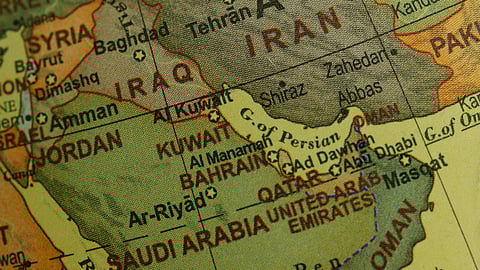


Neither full-scale war nor peace is taking hold in the Middle East, trapping energy markets in an uncomfortable limbo that won’t be easy to escape.
Worries about the reliability of Persian Gulf supplies are becoming increasingly entrenched among buyers, creating an alarming new norm for the region’s producers.
More than five months after the United States and Israel launched military strikes against Iran, the region's energy sector appears weaker and more vulnerable than at any point since the war began.
Shipping routes are increasingly constrained, energy infrastructure is coming under attack and importers are beginning to avoid supplies from a region that accounted for a fifth of global oil and liquefied natural gas exports before the war.
Making matters worse, the conflict has expanded in recent weeks from the Strait of Hormuz – the primary front in this war – to the Red Sea.
Yemen's Iran-backed Houthi militia last week declared an embargo on Saudi exports.
Attacks on tankers and other energy assets have severely complicated shipments from Saudi Arabia's west coast, which emerged as a critical alternative route after Hormuz was effectively shut earlier this year.
Meanwhile, the security situation continues to deteriorate after the unravelling of the US-Iran interim ceasefire deal on June 17.
Following a few days’ hiatus, the US military on Tuesday renewed strikes against Iranian targets in the region after Tehran and its allied militias in Yemen and Iraq targeted tankers and energy infrastructure, including two major refineries in Kuwait and Saudi Arabia that were forced to shut down.
The result is — once again — a dramatic decline in Middle East exports. Combined exports from the gulf and Saudi Arabia's west coast slipped this week to around 6.2 million barrels per day. That’s less than half the wartime peak of 13.4 million bpd hit in late June and far below the more than 20 million bpd that typically left the region before the conflict, according to data analytics firm Kpler.
But what is perhaps most alarming for energy markets is not this short-term volatility but signs that the complex, opaque trading patterns created by this stop-and-start conflict might be here to stay.
First, there’s the question of Iran’s control over the Strait of Hormuz.
After months of conflict, gulf states appear desperate to restore energy exports to replenish depleted state revenues. As a result, many are now willing to contemplate an idea that would have been almost unthinkable only weeks ago: granting Iran a formal role in managing traffic through the critical waterway.
Earlier this week, Oman presented Tehran with a gulf-backed proposal under which Iran would help administer the strait and collect voluntary fees from vessels using the route.
Iran rejected the proposal, insisting that the entire inbound shipping channel and part of the outbound route should fall under its control, according to an Iranian official.
Washington, for its part, has repeatedly rejected any suggestion that ships should pay tolls or fees to transit the strait.
Yet military realities are steadily narrowing the range of alternatives. US air strikes have so far failed to eliminate Tehran's ability to disrupt shipping while President Donald Trump appears reluctant to embark on a deeper regional war.
Under those circumstances, a compromise that gives Iran at least some degree of authority over Hormuz appears increasingly plausible.
An agreement that formalises Iran's influence over the world's most important energy chokepoint would be seen as a big win for Tehran and could carry far-reaching consequences.
The immediate financial impact is pretty clear-cut. A toll system would increase the cost of exporting oil and gas from the gulf.
The more profound consequence, however, would be psychological.
For decades, gulf energy supplies had reputations for reliability that allowed producers to command a premium from Asian buyers.
But the war has demonstrated that Iran can disrupt one of the world's most critical trade routes fairly easily using cheap means, such as drones and missiles.
Even if shipping resumes and a diplomatic agreement is reached, the threat will continue to hang over the region like a sword of Damocles.
That sword comes with a hefty price tag. If geopolitical risk now needs to be factored into purchasing decisions, gulf exporters will likely be forced to offer discounts to retain customers even if today’s physical disruptions are cleared.
Signs are already emerging that this is happening. India's state-owned Mangalore Refinery this week issued a crude purchase tender that, for the first time, explicitly asked suppliers to avoid using the Red Sea and the Strait of Hormuz. This is, in effect, requiring suppliers to continue using more expensive, less efficient routes no matter what happens between the US and Iran in the coming months.
More broadly, Asian and European importers of Middle East liquefied natural gas are planning to seek lower prices and stronger supply guarantees from Qatar and the United Arab Emirates, according to buyers, traders and industry executives interviewed by Reuters.
Higher insurance premiums, elevated shipping costs and persistent concerns over supply security may therefore soon become viewed as the cost of doing business in the gulf.
This new reality may, in turn, force gulf producers to agree to more bespoke, direct supply deals with importing nations outside today’s highly liquid and efficient market, rendering the energy market more opaque.
In effect, the Middle East may be drifting toward a new equilibrium in which energy continues to flow but under a constant shadow of coercion. The immediate crisis will eventually pass, but the damage to the region's reputation could prove far more enduring.
(By Ron Bousso; Editing by Nia Williams)
