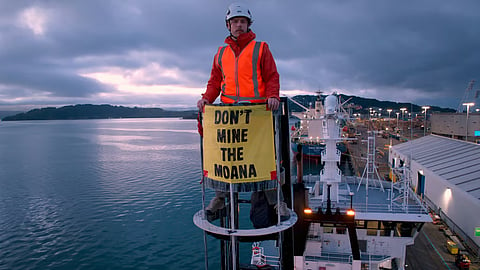

Five protesters from environmental activist group Greenpeace boarded and occupied the New Zealand Government-owned research ship Tangaroa in Wellington Harbour without authorisation after she returned from a Pacific seabed mineral survey on Saturday, September 26.
Police removed the attention-seeking activists after about seven hours and were considering charges.
One protester was dressed as US President Donald Trump and flew an American flag while another displayed a banner reading “Don’t mine the Moana”, one of the group’s oft-chanted slogans is response to seabed mining and related activities in the waters off New Zealand (pictured).
The vessel had been carrying out a 65-day survey in the Clarion-Clipperton Zone for UK Seabed Resources (UKSR), a wholly owned subsidiary of US company Glomar Minerals. The work covered UKSR’s exploration areas licensed by the International Seabed Authority (ISA).
Glomar said the survey gathered geological and biological data and samples in its UK2 licence area to update UKSR’s resource model and establish an environmental baseline. The company said the findings will inform plans for commercial recovery of polymetallic nodules and assessments of potential environmental impacts.
Glomar said the cruise marked UK2’s first extensive geological and biological examination in more than 40 years. Its two ISA exploration areas cover about 133,000 square kilometres of deep seafloor.
The company said the nodules contain manganese, cobalt, nickel, copper and rare earths.
Greenpeace’s local arm in New Zealand claimed that it occupied the vessel because a publicly owned ship was being used for research intended to support commercial seabed mining.
The group opposes nodule extraction over supposed risks to the deep sea environment and Pacific communities.
“It’s disturbing to see this vessel, which is owned by our government, being used to further American imperialism in the Pacific where resistance to this new form of extraction is strong,” Greenpeace Aotearoa’s Juressa Lee said.
Earth Sciences New Zealand, which operates Tangaroa, told RNZ it provides independent research to organisations in New Zealand and overseas and directed questions about UKSR’s project to the company.
“Our work includes scientific surveys that collect and analyse data to improve understanding of the deep-sea environment, including its biology and ecology,” the operator said.
New Zealand Minister for Resources Shane Jones defended the vessel’s use for the survey.
“Tangaroa is run by an independent board and a government-owned agency obviously driven to generate revenue as a part of its scientific mandate,” said Jones.
Greenpeace also criticised US efforts to pursue seabed mining outside the ISA process. In January, the Metals Company sought US approval to mine the international seabed under a separate proposal. The ISA’s rules for commercial exploitation remained unfinished after its July 2026 council session.
Since 2022, New Zealand has backed a mining pause subject to conditions in waters outside national jurisdictions. It is to remain in place until a mining code grounded in adequate scientific knowledge and safeguards for the marine environment is agreed; it does not apply within New Zealand’s jurisdiction.
Tangaroa is the only New Zealand deep-water research vessel equipped for ice conditions and dynamic positioning. Greenpeace activists also boarded the ship in 2015 in protest over its use in oil industry surveying.

