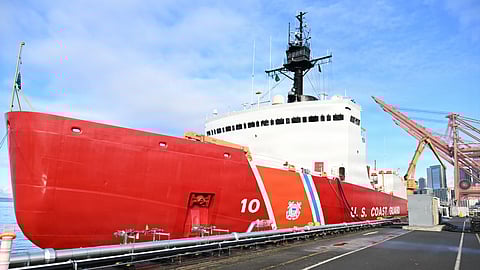

The US Coast Guard heavy icebreaker USCGC Polar Star departed McMurdo Sound in Antarctica on March 1 after operating for 55 days below the Antarctic Circle and traveling 14,000 miles (23,000 kilometres) in support of Operation Deep Freeze 2026.
During this same deployment, Polar Star assisted a cruise ship that had become trapped in pack ice.
A few days later, the icebreaker and her crew finished establishing a seven-mile (11-kilometre) channel through fast ice, creating a navigable route for vessels to reach McMurdo Station. Shortly after the route's establishment, Polar Star escorted the fuel tanker Stena Polaris into and out of Winter Quarter’s Bay through the brash ice-filled channel to deliver more than six million gallons (23 million litres) of fuel to McMurdo Station.
In late January 2026, the icebreaker spent five days moored at McMurdo Station, where crew members helped onload 300,000 gallons (1.1 million litres) of fuel.
After departing, Polar Star removed the 4,200-ton floating ice pier from Winter Quarters Bay into McMurdo Sound during a joint operation with the National Science Foundation (NSF). This cleared the bay for the arriving vessel Plantijngracht to conduct cargo operations via a US Army modular causeway system.
Shifting ice floes necessitated Plantijngracht requiring an escort from Polar Star to reach the protected waters in Winter Quarters Bay.
After cargo operations were complete and Plantijngracht departed, Polar Star conducted her fifth and final escort of the season to bring the tug Rachel through lingering late-season pack ice to deliver the new NSF Discovery Pier to McMurdo Station.
Polar Star departed Seattle in November for her 29th deployment to Antarctica in support of Operation Deep Freeze. Managed by the NSF, the mission provides logistical support for the US Antarctic Program.

