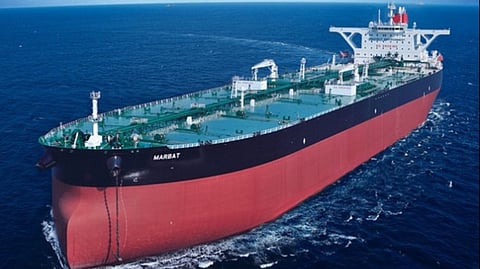

Supertanker costs in the Middle East have hit all-time highs, according to shipping data and industry sources on Tuesday, as the US-Iran conflict intensifies with Tehran attacking ships passing through the Strait of Hormuz.
Shipping through the Strait between Iran and Oman, which carries around one-fifth of oil consumed globally as well as large quantities of liquefied natural gas, has ground to a near halt after vessels in the area were hit as Iran retaliated against US and Israeli strikes.
The disruption and fears of prolonged closure have caused oil and European natural gas prices to jump, with Brent crude futures up nearly 10 per cent this week as the conflict triggered multiple oil and gas shutdowns in the Middle East.
The benchmark freight rate for the very large crude carriers (VLCCs) used to ship two million barrels of oil from the Middle East to China, also known as TD3, rose to an all-time high of W419 on Monday on the Worldscale industry measure used to calculate freight rates, or $423,736 per day, LSEG data showed.
The rate had doubled from Friday, extending gains from a six-year high hit last week, after the US and Israel attacked Iran and killed Supreme Leader Ayatollah Khamenei on Saturday. Iran has responded by attacking gulf countries, prompting precautionary shutdowns at oil and gas facilities across the Middle East.
An Iranian Revolutionary Guards senior official said on Monday that the Strait of Hormuz was closed. Iran would fire on any ship trying to pass, Iranian media reported.
Daily freight rates for LNG tankers jumped more than 40 per cent on Monday after Qatar halted production. Atlantic rates rose to $61,500 per day on Monday, up 43 per cent, or $18,750, from Friday, according to Spark Commodities, a pricing assessment agency for LNG shipping.
Pacific rates rose to $41,000 per day, up 45 per cent, or $12,750, from Friday. Fraser Carson, principal analyst for global LNG at energy consultancy Wood Mackenzie, said spot daily LNG shipping rates could rise above $100,000 this week on tight supply.
"Vessel availability for the rest of March is considered weak as cargo operators try to work through the backlog created by weather disruptions during February," he said. "There will be very strong competition for any available vessels."
Until safe passage through the Strait of Hormuz can be assured, shipping will remain idle, Carson said. An oil shipbroker who declined to be named due to company policy said it was very difficult to assess shipping rates in the Gulf as several shipowners had suspended operations indefinitely.
Meanwhile, bunker sales at Fujairah, a major bunkering port in the United Arab Emirates, have slowed as the conflict disrupted fuel supply, spurring a jump in prices and potentially shifting demand to other ports including Singapore.
South Korean shipping firm Hyundai Glovis said on Tuesday it was preparing contingency plans including securing alternative routes and ports.
South Korea's maritime ministry issued a notice to South Korean shippers with vessels sailing in the Middle East, asking them to refrain from business operations in the region. An official told Reuters on Tuesday.
(Reporting by Florence Tan and Emily Chow in Singapore; additional reporting by Heekyong Yang and Heejin Kim in Seoul. Editing by Christian Schmollinger and Kevin Liffey.)
