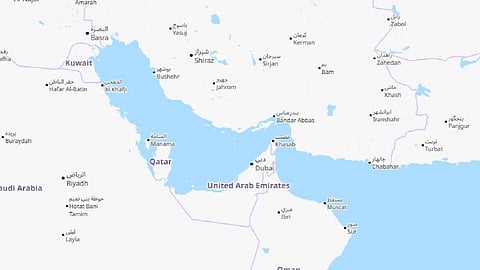


A QatarEnergy-controlled liquefied natural gas tanker exited the Strait of Hormuz overnight, the first such vessel recorded by ship-tracking data leaving the waterway since July 11, data from analytics firms showed on Thursday.
The Al Areesh, which loaded a cargo at Qatar's Ras Laffan terminal around July 4 to July 6, sailed on July 29 from the strait blockaded in the Iran war, data from Kpler and LSEG showed.
LSEG data shows it is currently heading to Port Qasim in Pakistan, estimated to arrive on July 31. It is the first time a QatarEnergy-controlled LNG tanker has exited the Strait of Hormuz since the Al Rekayyat was struck in early July.
On Thursday, Iran's Fars news agency said a Qatari ship laden with LNG traversed the Iran-designated route in the Strait of Hormuz with Iran's permission, but gave no details on the tanker.
The Strait of Hormuz carried a fifth of global supplies of crude oil and liquefied natural gas before it was blockaded in the war that began in February with US-Israeli strikes on Iran.
The previous LNG tanker to exit was the Al Hamra, which left on July 11 carrying a cargo loaded at the United Arab Emirates' Das Island, according to Kpler data.
Separately, the Mraweh LNG tanker, last detected outside the Strait of Hormuz in ballast on July 24, reappeared inside the strait on Thursday, according to Kpler and LSEG data. The ADNOC Gas-controlled vessel remained in ballast, Kpler data showed.
An ADNOC spokesperson said company policy was not to comment on the position, movements, or routing of its vessels.
QatarEnergy did not immediately respond to a request for comment outside of business hours.
Twelve commodity ships passed through the Strait of Hormuz on Wednesday, with six entering and six exiting, Kpler data showed. The number increased from the previous two days.
Nineteen commodity ships passed through the Bab el-Mandeb strait on Wednesday, down from the transit on Monday and Tuesday, Kpler data showed. LSEG put the number of transits at 26.
Of the 19 ships passing through according to Kpler, eight entered the strait while 11 exited. Among those exiting, four were tankers carrying crude.
Some ships could still be sailing with their transponders turned off, which are not considered in the counts.
Visible crude loadings from the Red Sea port of Yanbu fell by at least 30 per cent last week after Yemen's Houthis declared a blockade on Saudi Arabia, Kpler and AXSMarine data showed, though Vortexa estimated that exports remained broadly stable, citing a rise in so-called dark tanker loadings.
"We have observed a clear increase in the number of crude/condensate tankers heading north after loading in the Red Sea. The shift reflects the renewed security risk around Bab el-Mandeb," said Vortexa analyst George Morris.
"Cargoes loaded at Yanbu accounted for around 15 per cent of Asia's seaborne crude/condensate imports in June, so any sustained disruption has meaningful implications for Asian refiners."
(Reporting by Emily Chow and Siyi Liu in Singapore; Editing by Saad Sayeed and Clarence Fernandez)
