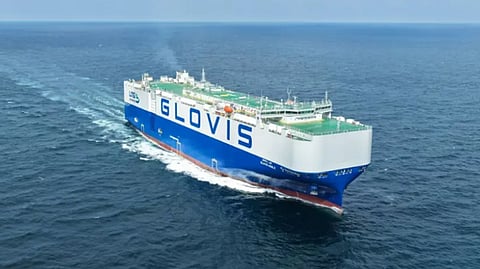
China State Shipbuilding Corporation (CSSC) subsidiary Shanghai Waigaoqiao Shipbuilding (SWS) has delivered a new LNG dual-fuel pure car and truck carrier (PCTC) to Korea Ocean Business Corporation (KOBC) four months ahead of schedule.
The naming ceremony for Glovis Noble took place on Monday, November 16. The vessel will operate under charter to South Korea's Hyundai Glovis.
SWS said Glovis Noble is the first 10,800CEU dual-fuel car carrier it has built for KOBC. Hyundai Glovis and KOBC described the vessel as the second delivery arising from their collaboration.
Glovis Noble is the second of six sisterships in a charter package that comprises four vessels for Seaspan and two for KOBC. Construction is divided between SWS and CSSC subsidiary Guangzhou Shipyard International (GSI).
GSI delivered the first KOBC vessel, Glovis Nova, in July.
The PCTC has a gross tonnage of 102,429, a length of 230 metres, and a beam of 40 metres.
Her cargo spaces span 14 vehicle decks, five of which are liftable to accommodate taller cargo such as buses, trailers and heavy construction equipment alongside passenger cars.
Sisterships in the series are able to carry electric vehicles as well as vehicles powered by hydrogen and LPG.
The vessel was designed by CSSC subsidiary Shanghai Merchant Ship Design and Research Institute.
Propulsion is provided by an LNG dual-fuel Everllence B&W 8S60ME-C GI main engine, allowing the ship to run on either LNG or conventional marine fuel.
The design shares its principal dimensions, deck count and capacity with the GSI-built Glovis Leader, which was delivered to HMM for Hyundai Glovis charter earlier this year.
Hyundai Glovis plans to have 128 vessels in its car carrier fleet by 2030, with annual vehicle shipments rising from 3.4 million to five million units.
