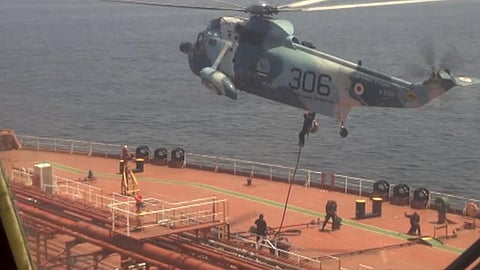


Seafaring has suddenly become more dangerous, and not just because of wind and weather.
With the daily sealift of energy out of the Gulf at a standstill, and the Strait of Hormuz “blockade” about the only ace left in the shattered Iranian pack, it is said that some 20,000 seafarers are currently at risk in their crowded anchorages.
The Iranian navy might be in ruins, but the ships offer a soft target to the cheap “suicide” drones, which need few facilities to launch along the long Iranian coastline.
Meanwhile, tethered by the enormous hike in insurance rates, as much as any fears about the crews’ welfare, the ships sit tight, those aboard them hoping for the best. They cannot exercise their rights to decline to sail and demand to get ashore, because there is nowhere to go, with air travel around the region largely on hold.
There have already been casualties of ships and seafarers, which reinforces the requirements for a standstill of traffic. Suggestions of convoys (which would imply warships entering the same confined and hazardous waters) and US-brokered insurance packages remain tenuous.
One can only hope that it ends soon, although there seem precious few signs of that.
Passage through the Red Sea, with all manner of dire threats uttered by whoever is in charge of the Houthi militants with their own drones, missiles and speedboats at the ready, is similarly hazardous, and it is notable that most responsible lines have resumed their long haul around South Africa.
Away from the main areas of activity, it is worth noting that a voyage through the Black Sea remains exceedingly hazardous for those aboard ships in transit.
Even the Mediterranean has become a combat zone, witness the shattered wreck of the first large LNG carrier ever to have been sunk by mysterious explosions targeting its Russian cargo. Its crew somehow escaped the inferno and were rescued.
As always, seafarers are the collateral damage in these outbreaks of institutional violence, which have simultaneously peaked in too many places at once. They have no choice but to hunker down, and any suggestions that it is “not their war” might be a futile protest to the four winds.
It is worth pointing out that in the national demographic of the seafaring workforce, and in particular those 20,000 or so trapped in the Gulf, there will be precious few merchant mariners from what might be described as the “combatant nations”.
Contrast this to earlier wars, where those in the firing lines mostly did have some sort of stake in the confrontation. The incoming ordnance, however, does not discriminate.
The usual well-meaning statements about innocent seafarers not having to endure such hazards have been made by the S-G of the IMO and others, but these are words and empty gestures, which people feel they must say without any real hope that they will have any effect whatsoever.
Such outbreaks of hostilities also underline the general pointlessness of the “open registry” flag states, with their “convenience” entirely cancelled whenever anything nasty happens.
Seafarers have long learned that they will have little recourse to any relief from flag states, when things take a turn for the worse.
One sometimes wonders whether the whole concept of a flag state, which can now be changed “on-line” and is solely a financial transaction, has become rather redundant. It is certainly emphasised by the situation today, where the frequently changing flag is often a deliberate effort to conceal the identity and beneficial ownership of a vessel.
The emergence of the “shadow” fleet has only served to underline the need for a proper reform of ship ownership and true responsibility, which for decades has made the maritime industry suffer embarrassing questioning about its respectability in global business.
But with the arrests of unregistered and sanctioned ships on the high seas and in third country territorial waters, it is the crews of the ships, probably ignorant of the illegality of their employers, who will be the fall guys.
Situation normal, it’s just the poor bloody infantry in the firing line, whether it is an arrest warrant or a Shahed drone winging its way towards them.
