People are missing the most important implication from China’s test of a submarine-launched ballistic missile (SLBM) on Monday.
It’s not the signalling of China’s power, though that was almost certainly in there. In part, it’s what the test confirms: China has now validated a new, long-range missile from a submerged submarine, extending its nuclear deterrent to sea and moving closer to a credible triad.
This, in turn, is just one element of a worrying Chinese nuclear modernisation and buildup. Countering this requires two parallel efforts: the United States and its allies must modernise their own deterrent capabilities, and they must simultaneously find ways to bring arms control back into play as a tool for constraining China’s buildup – though a near-term breakthrough on that front remains unlikely.
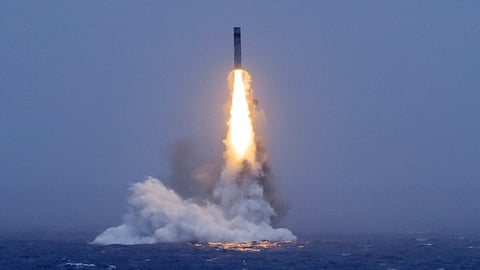
The July 6 test involved a nuclear-powered submarine firing the missile at long range into the South Pacific. It was the first publicly acknowledged test of this kind at this distance. The missile carried a dummy warhead and landed in a designated area following advance notification to regional governments, according to China’s state-run Xinhua news agency, which characterised the launch as a "routine arrangement" not directed at any target.
Regional reaction was swift and pointed. Australian Foreign Minister Penny Wong, speaking in Suva just hours after Canberra had signed a new defence pact with Fiji, called the test, "destabilising to the region," and said it must be viewed, "in the context of a rapid military buildup by China, which is lacking in the transparency and reassurance as to intent that the region expects." New Zealand Foreign Minister Winston Peters was equally direct, describing the launch as "an unwelcome and concerning development" and warning that the Pacific, "should not sit by and allow such tests to become normalised or routine."
Indeed, the timing was almost certainly not accidental, though the signing of the Australia–Fiji alliance was probably not the occasion that China was thinking of as it sent a signal of its military prowess. More likely, it wanted to put on a show a day ahead of a NATO summit in Ankara and to coincide with a joint naval exercise it was conducting with Russia.
Still, we should remember that nuclear powers, including the US, test their intercontinental ballistic missiles (ICBMs) and SLBMs routinely.
The immediate importance of this one is that it has proven that the missile and the submarine, both of new design, worked as designed. This means that the basing of China’s nuclear deterrent is extending into the safety of the sea. That is a significant and lasting shift in China’s strategic posture – and it’s the trend, not Monday’s headline, that Washington and its allies need to take seriously.
China has long tested its ICBMs and SLBMs, but it has traditionally done so within its own territory. In September 2024, however, it test-fired an ICBM from Hainan Island in southern China into the South Pacific near French Polynesia. This week’s test differs in one important respect: experts assess that it most likely involved a newer JL-3 SLBM, launched from a submarine of the Type 094 class, China’s newest ballistic-missile submarine design in service.
Since testing its first nuclear weapon in the 1960s, China has focused its strategic deterrent primarily on silo- and mobile-based land ICBMs. Over the past decade, however, Beijing has clearly been working to build a more survivable deterrent, one that, like the US’s and Russia’s, rests on a full triad of delivery systems, with delivery from the land, air and sea. As my colleague Evan Medeiros noted, "Most basically, China needed to technically validate its newest submarine-launched ballistic missile," but he added that, "there was a broader message to the world – China now has a fully operational nuclear triad." I think that analysis is essentially correct.
That said, it’s worth remembering that the US regularly tests SLBMs from its own ballistic-missile submarines. The US Navy’s Demonstration and Shakedown Operation (DASO) program involves launching unarmed Trident II D5 missiles from a submerged submarine to verify a crew’s combat readiness and the weapon system before deployment. In September 2021, while serving as principal deputy administrator of the US National Nuclear Security Administration – the agency that develops and maintains the US nuclear stockpile – I had the opportunity aboard USS Wyoming to observe a DASO shot. It was, to put it mildly, an extraordinary experience. Britain (as part of the US DASO program), France, and Russia conduct comparable tests.
So, on balance, the US and its allies, including Australia and Japan, should not be overly concerned about the test itself. What should concern us is what the test represents for the strategic balance in the Indo-Pacific, and for the broader nuclear balance among Russia, China, and the US. It is the geopolitical and strategic implications of the test, not the test as a discrete event, that warrant our attention.
As I have written elsewhere, the central strategic challenge confronting the US and its allies in the Indo-Pacific today is the rise of China and its rapid, largely unconstrained nuclear buildup. Beijing is expanding and diversifying its nuclear forces at a pace that directly affects US force structure, extended deterrence commitments, and escalation management across the region.
As the US Department of Defense noted last year in its annual report on China’s military power, "China’s stockpile of nuclear warheads remained in the low 600s through 2024, reflecting a slower rate of production when compared to previous years. Despite this slowdown, the [People’s Liberation Army] has continued its massive nuclear expansion… [and] the PLA remains on track to have over 1,000 warheads by 2030."
In my view, the US and its allies need to take several concrete steps in response to these developments.
First, the US needs to continue modernising its nuclear triad, with new Sentinel ICBMs, B-21 bombers, Long-Range Stand-Off cruise missiles and Columbia-class submarines, and it needs to update the Department of Energy’s nuclear infrastructure through its National Nuclear Security Administration.
Second, the US should consult closely with regional allies such as Japan, South Korea and Australia to determine what theatre nuclear capabilities are needed for regional deterrence. The US is already developing a nuclear sea-launched cruise missile, currently scheduled for deployment in the early 2030s. Washington should also consider the feasibility of an air-delivered system that could be carried by dual-capable aircraft such as the F-35, which would expand US delivery options.
Third, it is critical that the three nations in AUKUS – Australia, Britain and the US – continue to advance that initiative. AUKUS’s pillar one focuses on deploying nuclear-powered attack submarines, while pillar two focuses on advanced capabilities, including autonomous systems. As these capabilities come online, they will help sustain a more favourable conventional balance of power in the region.
Finally, the US should support allied efforts to acquire precision conventional strike capabilities, such as Japan’s acquisition of Tomahawk cruise missiles. As I noted in a June article for The Strategist, one of the central challenges here is constrained US defence-industrial capacity, which is delaying these sales. It is therefore imperative that the US work with allies to expand production capacity and resilience through co-production agreements on key munitions.
This raises a fundamental question: how can China eventually be brought into a meaningful arms control framework? Every US administration since President Bill Clinton’s has tried and failed to engage China on this issue. Beijing has consistently declined meaningful diplomatic engagement on nuclear arms control. That posture may have been tolerable when China possessed only a few hundred warheads; it is no longer sustainable given the pace and scale of China’s current buildup.
History suggests China may be most willing to come to the negotiating table only when faced with deployments by others that impose tangible strategic and economic costs – much as NATO’s response to Soviet deployments of intermediate-range nuclear forces in the 1980s eventually brought Moscow to the table. Regrettably, this implies the US may first need to expand certain military capabilities to create the conditions necessary for eventual arms control.
The fundamental issue arising from China’s SLBMs is where China’s strategic trajectory is headed. The available evidence suggests Beijing is seeking to approach parity with the US in deployed nuclear forces by the mid-2030s. The real question, then, is how the US should work with its Indo-Pacific allies to address this challenge. In my view, that will require a mix of nuclear and conventional capabilities, alongside a sustained effort to eventually constrain Chinese capabilities through arms control – though that outcome is unlikely until the US and its allies find ways to impose enough costs on Beijing to bring it to the table.
Article reprinted with permission from the Australian Strategic Policy Institute's analysis and commentary site The Strategist.

