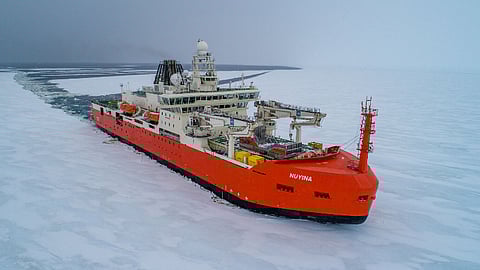
A preliminary investigation report published by the Australian Transport Safety Bureau (ATSB) details the circumstances leading up to the brief grounding of the Australian icebreaking research vessel Nuyina off Heard Island, 4,000 kilometres southwest of Perth, last October.
The report details evidence gathered so far in the ongoing transport safety investigation into the October 13, 2025 incident, but does not contain analysis or findings, which will be published in a final report at the conclusion of the ATSB's investigation.
“The grounding occurred while Nuyina, the Australian Antarctic Division’s research and supply vessel, was conducting drone survey operations over the shore of Heard Island, close to an area of uncharted seafloor,” ATSB Chief Commissioner Angus Mitchell said.
On board the vessel were 37 marine crew and 85 expeditioners.
“Nuyina had several scientific instruments installed on a retractable drop keel, which at the time of the incident was extended 75 centimetres below the vessel’s nominal nine-metre draught,” Mr Mitchell explained.
“One of the drop keel devices was a high-resolution multi-beam echosounder system, which was still collecting data, after having been used for overnight bathymetric surveys in deeper water.”
To avoid acoustic interference, the ship’s navigational echosounders were switched off.
"Depth information from the multi-beam system was shown on a dedicated display on the bridge but was not fed into the ship’s integrated bridge system," Mr Mitchell said. "This meant the depth information was not displayed on the electronic chart display and information system (ECDIS), and could not be used to generate navigational alarms."
Nuyina had been conducting the drone aerial survey work while holding position using its dynamic positioning system off Fur Seal beach before the voyage leader requested the master reposition the ship to a new location around five miles (eight kilometres) to the north-west, the preliminary report detailed.
After discussion with the second officer, the master then planned a route to the new location on the ECDIS planning station in the aft area of the bridge, conducted a route check, and loaded it in the system.
The second officer then began turning the ship towards the intended course, which increased the load on the on thrusters as it turned abeam to the wind. On the master’s request, the second officer then took the ship on manual control and began the transit.
However, at this point they noted that the new route was not visible on the forward ECDIS.
While the master tried to correct this issue with the ECDIS, the second officer followed an electronic bearing line that had been loaded earlier to guide the ship along the coast while it was conducting the drone flights.
“This bearing line was in a similar direction to the planned route, taking the ship between an unsurveyed area to the west and a charted bank to the east,” Mr Mitchell explained.
A short time later, the acoustics operator contacted the bridge by phone to advise that the multibeam was showing a depth of 15 metres. Shortly after, the master ordered "stop engines" followed a short time later by "dead slow astern".
At about the same time, the acoustics operator contacted the bridge again, to warn of shallow water. However, Nuyina then briefly grounded, with its retractable drop keel initially impacting the seabed, followed by the ship’s hull.
The vessel then cleared the shallow water and drifted away from the coast, before the crew stopped its movement and held position.
with mounted instruments damaged or missing. The hull of the ship itself only sustained scratches and paint damage.
The drop keel was retracted for inspection, revealing substantial damage
After consultation with the relevant authorities and experts ashore, Nuyina continued its operations at Heard Island as well as a scheduled resupply operation at Davis station in Antarctica before returning to Hobart.
Mr Mitchell said the ATSB’s investigation had so far included interviews with key personnel, examination of recorded data and CCTV footage, and the gathering of operational documentation and historic and recorded bathymetric data.
“As the investigation proceeds, the ATSB will examine operator procedures, as well as recorded data from the vessel and the bathymetric data, before determining the safety factors that contributed to this occurrence,” he said.
A final report will be released at the conclusion of the investigation.

