

It is the clean energy of the future, everyone tells us, but a lot of unknown hazards seem to come with it, on land, sea and air.
There was a disturbing news item in the UK newspapers just recently about a worrying increase in fires and explosions in refuse transfer stations, where household garbage is collected for ongoing transport.
Scarcely a day goes by, the authorities imply, without a fire, mainly attributed to batteries being chucked in with the general waste, where the machinery used to compact the garbage squashes them and sets off sparks. The sight of a blazing rubbish lorry, an early victim of this plague, is by no means unusual.
It is strange how stuff comes around. Eighty years ago, it was hot ashes, caused by impatient folk clearing out their grates, that regularly caused the dustmen grief. But this is forecast to get a whole lot worse, as the sheer number of batteries, in every sort of form and device, multiplies spectacularly. We surely must become a whole lot better at safe disposal.
It is not that long ago we were worrying about old refrigerator mountains, in the aftermath of the scare about the ozone layer. Now there will need to be safe and simple systems for the handling and disposal of million upon million of old EV batteries, and you would not put money on the emergence of a cheap and cheerful army of dodgy disposers.
There was a huge fire in the hold of a bulk carrier in a UK port which the Marine Accident Investigation Branch attributed to batteries being mixed up in a scrap cargo that was being loaded for export. It was a blessing that it happened in port, rather than on the voyage, and something of a comfort to learn that the shipper responsible for the cargo mix had gone out of business.
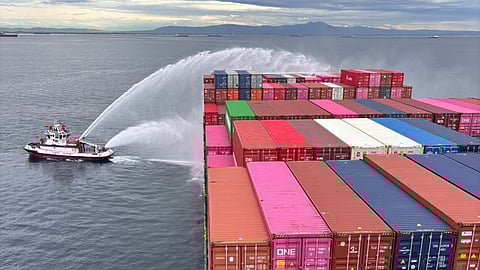
Although the exact source has still to be precisely identified, it is more than a suspicion that the conflagration in Los Angeles aboard the containership ONE Henry Hudson had an electrical origin.
There was an astonishing picture taken when the containership had been taken to a safe anchorage, which showed one of the container holds – full to the level of the coaming – in water, a rich chemical mixture that required specialist disposal.
It was notable that the fires and explosions aboard this ship appeared to have occurred not in a hazardous cargo stack on deck, but deep in a hold, which begets further explanation. That little emergency has been roughly estimated to have a price tag of half a billion dollars.
The insurance market is still digesting the aftermath of the X-Press Pearl and other calamities that have been attributed to container contents, misdeclarations, and people lying imaginatively about hazardous goods. Some have suggested that carriers have regarded this as almost a zero-sum game and concluded that it probably won’t happen to them, but the potential for something really awful is not changing for the better.
The shameful thing is that I was writing articles much along the same lines a quarter century ago. It seems repetition does not improve learning.
There are still deep concerns around companies involved in sea carriage about the accuracy of cargo declarations on container contents and also weights, despite all the mandatory requirements that have been implemented. We hear Maersk is the latest clamping down.
It was always going to be all about enforcement, and with the best will in the world, there will always be places with a cavalier attitude to the safety of containers. The big carriers have been polishing their systems that have been designed to identify shippers whose boxes need to be checked, However, as soon as you close down one cowboy shipper by refusing to carry its goods, another springs up to take its place, possibly employing the same cowboys.
Just think about the proportion of inspected containers that revealed deficiencies. It was significant, with more than 11 per cent showing up problems.
It has been suggested that there is almost something ingrained in the lines about not being willing to take a robust stand against rogue shippers. “They are, after all, the customers and if we are nasty to them, they will go somewhere else to get their rubbish shipped”.
But you would not get the airlines being so tolerant and the excuse that aviation is so much more “life and death” does not wash. It will be recalled that the toll of seafarers killed and injured by these accidents only grows.
