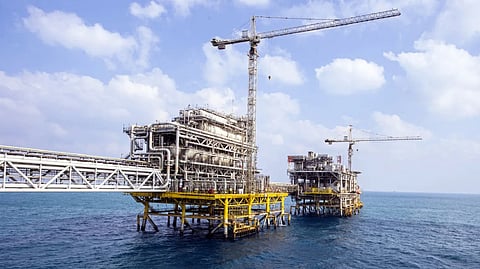

Saudi oil giant Aramco has begun cutting output at two of its oilfields, two sources said on Monday, after the vital Strait of Hormuz was choked by the US-Israeli war on Iran and subsequent attacks on the waterway.
It was not immediately clear at which fields and by how much production was being curtailed.
Aramco, which has been rerouting some of its crude cargoes to the Red Sea port of Yanbu, declined to comment.
The reductions by the world's top oil exporter underscore the severe logistical bottlenecks in the region since the US and Israel began attacking Iran on February 28 and Tehran responded by launching hundreds of missiles and drones, including at gulf countries hosting US military facilities.
Several of Saudi Arabia's neighbours have also cut production as shipping in the oil transit chokepoint, carrying roughly a fifth of global oil and liquefied natural gas flows, has ground to a near halt.
Kuwait Petroleum Corporation has reduced oil output and declared force majeure on shipments, while Qatar halted liquefied natural gas (LNG) production at its massive Ras Laffan export hub following drone strikes and also declared force majeure.
Oil production from Iraq's main southern fields has dropped by about 70 per cent as storage limits are reached, the United Arab Emirates' ADNOC is reducing offshore output and Bahrain's Bapco Energies also declared force majeure.
The unprecedented disruption has roiled global energy markets, pushing Brent crude futures to their highest levels since mid-2022 at close to $120 a barrel.
While Saudi Arabia has accelerated crude shipments from the Red Sea via the East-West pipeline to Yanbu, the redirected volumes are insufficient to offset the millions of barrels sidelined by the gulf closure, analysts have said.
That could leave consumers and businesses worldwide facing months of elevated fuel prices, as suppliers grapple with damaged infrastructure and paralysed logistics even if hostilities cease quickly.
(Reporting by Yousef Saba; Editing by Jan Harvey, Kirsten Donovan)
