The 2026 European International Submarine Races (EISR) concluded on July 10 at QinetiQ's Ocean Basin in Gosport, UK, after five days of competition between university teams from around the world.
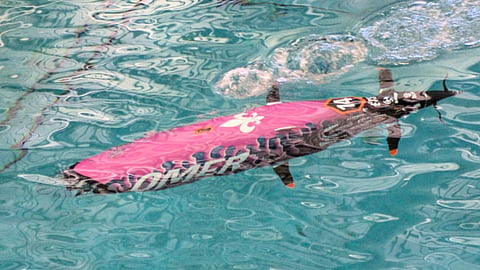
Defending champions Team OMER, from École de Technologie Supérieure (ETS) in Montréal, retained their title, winning the Hill Trophy and recording the fastest run of the competition at 6.36 knots. Virginia Tech were runners-up, with a top speed of 4.50 knots.
The Sir Robert Hill Memorial Trophy is named after Sir Bob Hill, a Vice Admiral of the Royal Navy and one of the founders of the EISR.

Nineteen teams entered qualification, with 12 advancing to the final: Virginia Tech, ETS, the University of Washington, the University of Michigan, Singapore Institute of Technology, National Cheng Kung University, the University of British Columbia, Kumaraguru College of Technology, the University of Warwick, the University of Victoria, Gdańsk Polytechnic University and the University of Southampton.
Teams raced their human-powered submarines over a 200-metre course at a depth of up to six metres, each run combining a timing-gate sprint, a 180-degree turn and a progressively harder slalom. The demanding course tested hydrodynamic efficiency, manoeuvrability, propulsion performance and pilot endurance.
Several teams improved their times over the course of the week as they refined their submarines between race days.
The organisers said that beyond the racing, the competition gave students hands-on experience in naval architecture, propulsion, hydrodynamics and underwater vehicle design, alongside opportunities to exchange ideas with peers, judges and industry representatives.
For the first time, the racing was livestreamed on YouTube, and the full broadcast remains available to watch back via the EISR website. Footage from the final three days of the races can also be viewed via EISR's official YouTube channel.
Each of the participating submarines is human-powered and fully designed and built by a team of university students. The submarines are able to operate safely at depths of three to six metres, where they float neutrally buoyantly.
The submarines were built to be fully flooded, and the pilots breathe air through scuba systems, hence the requirement for pilots who are also qualified divers.
Each submarine's pilot straps their feet into a set of pedals and drives a propeller or other propulsion system using muscle-power alone. Steering is achieved with joysticks and mechanical or mechatronic control systems driving rudders and diveplanes.
This year's races were hosted by QinetiQ and the Institute of Marine Engineering, Science and Technology.
The EISR has been held biennially since 2012. More information on the two-week event is available via www.subrace.eu.
