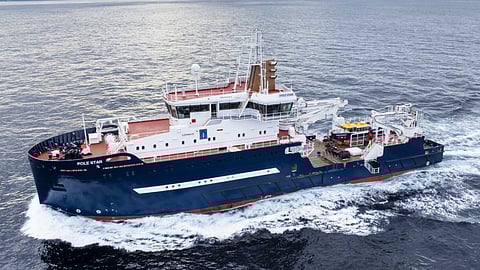


This large, state-of-the-art hybrid buoy tender and lighthouse support vessel was built by Astilleros Gondán in Spain, with design input from Seaplace and Denmark's OSK Design.
Pole Star features a sophisticated hybrid-electric propulsion system integrating a 4,644kW battery bank. This enables zero-emission navigation in sensitive areas, low vibration, reduced noise, and high efficiency through advanced energy management, thermal control, and safety engineering.
With accommodation for 16 crew and a range of 7,056 nautical miles, Pole Star delivers enhanced capability, environmental performance, and operational efficiency for the NLB’s vital work in challenging waters.

"She represents the current state-of-the-art in ship design applied to one of the most historic maritime institutions in the world," Seaplace Technical Manager Caridad Garcia told Baird Maritime.
"Every element of her design reflects contemporary best practice: hybrid diesel-electric propulsion with battery integration, optimised hull lines for North Atlantic seakeeping, advanced power management systems, reduced underwater radiated noise, highly efficient deck logistics for buoy handling, and high-standard accommodation designed to enhance crew well-being through low noise and vibration levels, natural light, and ergonomic living spaces."
"Pole Star is special because she combines high-capability lighthouse and buoy-tending with a low-carbon design," added Luis Mourelle, Sales Manager at Gondán. "Her hybrid diesel-electric propulsion and large battery capacity enable a much more efficient operating profile, while the deck equipment—three cranes including a 20-ton offshore crane—make her a true working platform for demanding operations in Scottish and Isle of Man waters."
"At the core of the design is a robust and carefully optimised hull form, which provides excellent seakeeping and reliable station-keeping capabilities, even under heavy weather conditions," remarked Henrique Pestana, Head of Sales at OSK Design, which was responsible for the concept design, supporting NLB during the tender phase and project supervision. "This allows the vessel to maintain safe and precise operations in exposed areas where environmental conditions can change rapidly."
The design is centered around a large working deck and a heavy-duty crane, specifically developed to handle and lift heavy buoys safely on board. For lighthouse servicing, the vessel also carries a smaller, specially designed workboat, enabling flexible and efficient operations close to shore.
"Beyond her operational capabilities, Pole Star is a modern hybrid diesel-electric vessel with a strong focus on redundancy, energy efficiency, and operational reliability," Pestana said. "The design incorporates state-of-the-art technology solutions to ensure safe operation, reduced environmental impact, and optimised energy consumption. Together, these elements result in a highly capable, future-proof workboat where hull design forms the foundation for performance, safety, and sustainability."
In Pestana's view, the main challenge in the project was in designing a vessel with a low draught while ensuring the ability to operate in the Sound of Harris as well as sufficient seaworthiness for all other operating areas.

"Interpreting and fully understanding the owner’s needs is always a challenge," added Garcia. "In this project, we received an initial concept and had to assess its feasibility while ensuring compliance with the contractual requirements. After that, we increased the vessel’s beam to secure stability while maintaining a restricted draught. This also improved seakeeping performance, reducing motions during maintenance work in demanding sea states."
Garcia commented that identifying potential design risks at an early stage was another key step, as it allowed for proactive follow-ups during construction and helped prevent the occurrence of unexpected issues as the project progressed.
"The build was challenging mainly because of the constraints: DP2 and buoy-tending capability for severe sea states, with a draught limited to 3.4 metres," said Mourelle. "It required careful coordination across the ship's various aspects—power, propulsion and arrangement."
Pole Star was designed to incorporate hybrid propulsion in line with the need to reduce greenhouse gas emissions, which Seaplace's Garcia said is a "main driver" impacting naval architecture.
"Ships designed today will sail until 2050 and beyond, so designers must balance what is feasible now with what will remain valid in the future. This leads to 'ready' ships that are more flexible rather than purely optimised designs."

Pestana meanwhile believes that sustainability and energy efficiency remain the dominant drivers in naval architecture, which is influenced by increasingly stringent environmental regulations.
"This is accelerating the adoption of hybrid and alternative propulsion systems, advanced energy management solutions, and optimised hull designs aimed at reducing emissions and fuel consumption," he told Baird Maritime. "In parallel, there is a growing focus on lifecycle efficiency, redundancy, and digitalisation, ensuring vessels are not only compliant at delivery but remain efficient, safe, and adaptable throughout their operational lives."
Amid the need to satisfy environmental regulations, OSK Design had a "strong and encouraging" 2025, as Pestana observed.
"Activity levels have remained high across our core segments, including passenger vessels, offshore wind, defence and specialised service vessels. Demand for purpose-built designs continues to be solid, reflecting owners’ increasing focus on operational efficiency, reliability, and long-term value.
"Compared to the past few years, we see greater stability in project pipelines and a more mature dialogue with clients regarding sustainability and future regulatory requirements. Overall, we are optimistic about the future, as these developments align closely with OSK Design’s core competencies and long-standing design philosophy."
For Seaplace, 2025 was a year of stability, according to Manuel Moreu, the design firm's General Manager.
"Our business, traditionally linked to the hydrocarbon sector, has always been somewhat volatile and highly dependent on market cycles," said Moreu. "However, in recent years, we have diversified into other applications and segments, which has helped smooth out the typical peaks and downturns. As a result, 2025 has been a relatively stable and positive year compared to previous cycles.
"Looking ahead, we are cautiously optimistic. The increasing demand for more efficient and sustainable vessels, together with diversification into new energy markets, gives us confidence in a more balanced and sustainable future."
For that same future, Moreu predicts that the global workboat industry will see areas such as offshore wind energy, submarine power cable installation and maintenance, open-water aquaculture, and even seabed resource activities become strong drivers of demand, as those sectors will require increasingly specialised vessels capable of operating safely and efficiently in harsher and more remote environments.
Gondan's Mourelle agrees with the notion of specialised vessels becoming more prevalent while adding that alternative propulsion systems will also proliferate.
"We’ll see hybrid and low-emission solutions become more common, not just for compliance but because customers want better efficiency in real operating profiles," he told Baird Maritime. "At the same time, digitalisation will accelerate—more monitoring, more data-driven maintenance, and higher expectations around reliability and uptime.
"Finally, owners will keep asking for workboats that are purpose-built for specific missions, with safety, operability and lifecycle cost designed in from the start."
Pestana remarked that, as a result of the growing demand for specialised vessels, a growing number of vessel owners are seeking early involvement from designers at the project inception stage, rather than relying on shipyards’ off-the-shelf designs.
"This early collaboration allows for better optimisation of hull form, propulsion, and onboard systems, ultimately delivering higher operational efficiency and lower lifecycle costs. In parallel, we expect continued advances in hybrid and electric propulsion, energy management systems, and smarter vessel operations, driven by both regulatory pressure and rising fuel costs."
Pestana said that even as costs rise, the Danish and wider Scandinavian maritime industry remains highly competitive due to the strong value added through forefront innovation in ship design.
"Scandinavian companies have a long tradition of combining technical excellence, practical operational insight, and early adoption of green technologies. As a result, many shipowners continue to engage with Scandinavian designers, recognising that high-quality design, optimised solutions, and innovative thinking deliver long-term benefits that outweigh initial cost considerations. Looking ahead, we expect the region to maintain a leading role in sustainable vessel concepts, digitalisation, and energy-efficient ship design."
Meanwhile, for the Spanish and broader European maritime industry, Seaplace's Moreu commented that shipbuilding is due for a revival.
"Europe, and Spain to an even greater extent, has lost relevance on the global shipbuilding stage compared to its position fifty years ago," he told Baird Maritime. "However, in the current context of reindustrialisation and strategic autonomy, shipbuilding should once again become a priority sector.
"There is broad agreement on the need to secure strategic industries such as semiconductor manufacturing, but ships have been strategic assets for millennia — and will continue to be. Maritime transport, offshore energy, defence, and subsea infrastructure all depend on strong naval and shipbuilding capabilities."
Moreu explained that going forward, Europe is unlikely to compete with Asia in terms of volume, but it can still lead in high-value, specialised vessels such as offshore energy support vessels, naval vessels, and technologically complex ships with high environmental standards. Innovation in decarbonisation, digitalisation, autonomy, and advanced materials will therefore become key areas of differentiation.
"If supported by coherent industrial policies and investment in engineering talent, the European shipbuilding industry can regain relevance as a strategic sector."
For a list of the 2025 "Best Of" award winners, please click here.

