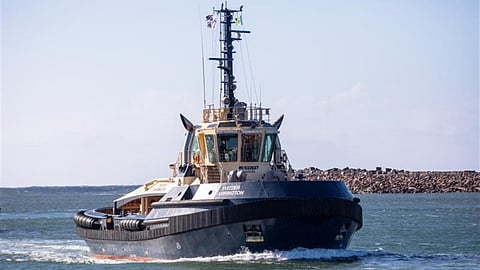

This pair of Robert Allan Ltd (RAL) designed compact, high-performance harbour escort tugs was recently delivered to Svitzer Australia for operations at the Port of Newcastle, one of Australia's busiest coal export ports.
Each tug boasts exceptional manoeuvrability and efficiency in confined, high-traffic harbour environments, with the patented “half-circle” towing staple optimising the pivot point for superior turning and stability without additional hardware.
A double-ended hull and symmetrical propulsion enable true omnidirectional thrust, bidirectional sailing and rapid, agile response, while the slender profile allows close-quarters work near flared vessel hulls. The high bow also provides better performance in rough conditions.

"Emergence occurs when a system becomes more than the sum of its individual parts," Ryan Ayres, Senior Naval Architect and Project Director at RAL, told Baird Maritime. "Svitzer Barrington is therefore special not only for its propulsion configuration, staple, equipment, and hull form, but for how these features work together.
"The close collaboration between designer and owner, the willingness to challenge convention, and the commitment to thorough testing and training all contribute to a cohesive whole that elevates the vessel beyond its individual parts."
"What really sets Svitzer Barrington apart is how much control it gives the crew and the pilot," added David Phillips, Chief Operating Officer at Svitzer Australia. "The design allows the tug to generate steering and braking forces in any direction, which is a step change from conventional tugs.
"It’s powerful, but more importantly it’s precise, as you can apply force exactly where and when it’s needed. It’s an extremely versatile vessel that’s capable of high-performance escort work as well as day-to-day harbour towage."
Phillips said that versatility means the tug can handle a wide range of ship types and operating conditions, even in confined waters or difficult weather. The tug was able to demonstrate that it can complete jobs efficiently while using less fuel than comparable designs, which benefits both customers and the environment.
It has also proven itself capable of working safely across a broader range of sea states, which improves port resilience and reduces delays. Phillips remarked that such an attribute is particularly important in the Port of Newcastle, where the channel is narrow, traffic is heavy and conditions can change quickly.

Phillips remarked that since the tug featured a completely new propulsion concept, the learning curve meant that the focus during commissioning needed to be on training and familiarisation.
"The vessel behaves differently from traditional tug designs, so building confidence on the controls was critical. Extensive simulator work and sea trials paid off. Once crews understood how the tug responds, they found it very intuitive to operate."
For Phillips, the key lesson is that innovation only delivers its full value when an operator invests just as heavily in its people as it does in technology.
Meanwhile, RAL's CFD studies during the design work on the tug revealed potential advantages in significantly modifying the hull form and staple position. However, for this theory to be validated, the company needed to pause the then-ongoing design work to conduct a new round of model testing – "a difficult but important decision," according to Ayres.
"The results of that testing confirmed the expected performance benefits, and this design change has since proven to be a major contributor to the exceptional capability of Svitzer Barrington today."
Ayres said the key lesson for the RAL project team was the value of staying open to better solutions and maintaining the agility to change course when needed.
Svitzer has also applied this practice of being agile. As explained by Phillips, the company is aware of decarbonisation placing pressure on the shipowning sector to reduce emissions, and so steps are already being taken in line with this rising trend.
"We’ve set clear global targets to reduce our CO₂ intensity and move toward climate neutrality," he told Baird Maritime. "That means improving efficiency today while preparing for future fuel transitions. Svitzer Barrington’s design contributes directly to that – it delivers the required performance with lower power demand compared to conventional tugs.
"In practical terms, that means lower fuel consumption and reduced emissions per job without sacrificing capability."
The acquisition of Svitzer Barrington and Svitzer Nobbys was just one of the notable developments that occurred in 2025, which Phillips described as a solid year for Svitzer Australia.
"Trade volumes have remained resilient, and demand for reliable towage services is strong. Ports are handling larger vessels on tighter schedules, which places a premium on safety and performance."
In Phillips' view, the operating environment is challenging, but fundamentally strong. The company is therefore optimistic about the future of the towage industry, both globally and within Australia.
"Maritime trade underpins Australia’s economy, and towage is a critical link in that chain. Ships are getting larger, ports are busier and weather patterns are becoming less predictable. That increases the need for highly capable towage to maintain safety and efficiency."
Phillips said that historically meant progressively more powerful and therefore more fuel-intensive tugs, though Svitzer Barrington's design challenges that assumption by delivering higher performance more efficiently.
"The future will require vessels that combine capability, resilience and sustainability, rather than trading one off against another," he told Baird Maritime.
For a list of the 2025 "Best Of" award winners, please click here.

