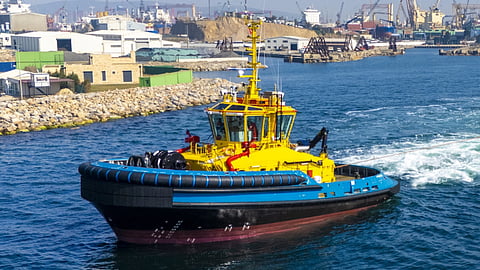


This pioneering electric terminal support tug for operations at the Puerto Chacabuco oil terminal in the Aysén region of Chile was designed by Canadian naval architecture firm Robert Allan Ltd (RAL).
The first electric tug to enter service in Latin America, her power comes from a substantial 3,616kWh lithium-ion battery pack, distributed across two compartments, driving two 2,100kW electric azimuthing thrusters, delivering a powerful 70-tonne bollard pull and a maximum speed of 12.5 knots.
Optimised for reduced hull resistance and maximum energy efficiency, the compact 25.4-metre tug accommodates a crew of seven and focuses on reliable berthing and unberthing assistance in challenging southern Chilean waters.

"Trapananda is an updated version of the successful 23-metre electric tug design, which was also developed for the same owner," Mark Bonar, RAL Naval Architect and Project Manager, told Baird Maritime.
"The larger envelope offered by the 25-metre design adds additional accommodation and battery capacity while maintaining the same core tenants as the smaller sister ship – excellent sightlines, extensive fendering, and a hull form optimised specifically for low resistance at operational speeds."
Bonar remarked that Trapananda is proof that electrification can enhance, rather than limit, tug capability.
"What makes Trapananda special is not only its technology, but how it reflects our approach to building solutions together with our clients," added owner Saam. "The tug represents an alignment between environmental performance and operational requirements. It is not about applying a one-size-fits-all green solution, but about delivering the best balance between efficiency, reliability and sustainability for each operation, always with a focus on providing the best standard for our clients."
Saam said that, as with any new technology, the commissioning of its electric tugs involved several challenges, particularly in areas such as vessel design, charging infrastructure, crew training and overall project feasibility.
"One key lesson from working with teams and suppliers in Canada was the importance of aligning the vessel design with the specific operational profile of each port, especially when defining battery capacity and autonomy. We also learned that developing robust onshore charging infrastructure is critical to ensure reliable operations."
The owner remarked that another important takeaway related to people. Operating an electric tug requires new capabilities, and investing in crew training and building familiarity with energy management systems proved essential for a smooth transition.
"Overall, the experience reinforced that advancing toward electromobility is not just about introducing new technology, but about integrating design, infrastructure, operations and people into a single, coordinated solution."
"A core challenge with electric tug design is optimising space allocation while maintaining a functional, flexible vessel platform," added Bonar. "Efficiently packaging the primary machinery on board – L-drives, batteries, switchboard and generators – allows for a full lower accommodation space and therefore enables a more compact deckhouse design. This improves operator visibility, reduces contact risk with assisted ships, and provides large clear working decks fore and aft."

Bonar added that the selected arrangement offers flexibility for vessel owners to optimise the quantity of installed batteries from between 1,800 kWh to over 5,000 kWH without adverse effects to vessel trim and stability.
The adoption of electric propulsion for Trapananda is in line with the ongoing energy transition, which Saam identified as a trend impacting shipowning.
"One of the main drivers is the energy transition, with the industry moving towards more efficient and lower-impact solutions," Saam told Baird Maritime. "This includes not only the electrification of vessels, but also the use of alternative fuels such as renewable fuels, as well as retrofit initiatives to extend the lives and improve the efficiency of existing assets.
"At the same time, there is a strong focus on optimising the use of traditional fuels, including more efficient diesel management, to reduce emissions over the short term. There is also a growing focus on maintaining high standards of safety and operational excellence, which remain essential across the industry."
Saam said that its focus is on finding the most optimal solution for each case, depending on operational needs, infrastructure and customer requirements. The company said this adaptive approach is what allows it to, "move forward in a practical and sustainable way."
The delivery of Trapananda was completed in 2025, which Saam said was a year of consolidation and progress.
"We have continued strengthening our operations, integrating capabilities and advancing under a common standard across our network. This process is part of a broader effort to position ourselves as 'best in class,' which is a core principle guiding our strategy.
"We have developed a unique operating system across our network, with consistent standards, a modern fleet and high-quality maintenance, ensuring that a tug is always available with the highest level of performance and reliability. This is supported by highly skilled and professional crews, which are a key part of our value proposition."
Saam remarked that this operating model has allowed it to project a new cycle of growth, supported by a more integrated organisation, consistent standards and a clearer long-term vision. The company therefore remains focused on strengthening operational excellence while continuing to grow in a sustainable and efficient way.
This growth is considered timely, for Saam has observed that the maritime sector today is characterised by increased consolidation, digital transformation, and a rigorous focus on environmental sustainability.
"For Saam Towage, these trends represent an opportunity for us to broaden our geographic presence and synchronise best practices across our network. This strategic evolution is essential for scaling our technical capabilities and upholding rigourous safety standards across all international markets. Today, we operate across a broad footprint, from Canada to South America, which gives us access to insights from very different markets."
Saam said this positioning allows it to not only understand trends, but also to actively drive them by transferring knowledge, standards and best practices across regions, particularly in its home region in South America.
"In South America, as we do in Canada and Central America, we see an opportunity to continue strengthening our position through greater integration, higher operational standards and solutions that respond to the specific realities of each market," the company told Baird Maritime. "At the same time, what we have built in the Americas provides a strong platform to look beyond the region.
"Our experience operating under a single model, with consistent standards and a clear long-term vision, allows us to explore new markets in a disciplined and sustainable way."
For a list of the 2025 "Best Of" award winners, please click here.

