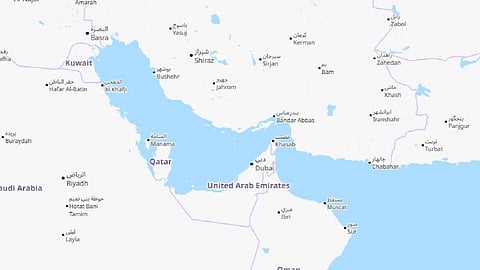


The possible collapse of US-Iran peace talks and the stop-start flow of tankers through the Strait of Hormuz are a nightmare scenario for Persian Gulf nations desperate to return to normal after a bruising multi-month conflict.
What was meant to mark the start of a fragile recovery following the June 17 memorandum of understanding between Tehran and Washington is instead evolving into a period of chronic instability, with each new incident reinforcing doubts over the security of one of the world's most important energy arteries.
US President Donald Trump on Wednesday declared that the interim agreement to end the war with Iran was "over" after the latest round of tit-for-tat attacks in the region.
Tehran kicked off the escalation on Tuesday by reportedly striking Qatari and Saudi fuel tankers crossing the strait, an apparent attempt to underline its longstanding claim that it should maintain control over the narrow waterway.
The US responded with strikes on dozens of targets across Iran, prompting attacks by Tehran against US military facilities in Bahrain and Kuwait.
The latest confrontation is not the first violation of the MOU, but it is by far the most serious.
Crude oil prices surged six per cent on Wednesday to a two-week high of nearly $80 a barrel, reflecting growing fears that the ceasefire framework underpinning the region's recovery may be unravelling.
Neither side likely wants to return to an all-out war, at least not now. Trump remains mindful that resuming hostilities could send energy prices soaring in the lead-up to November’s midterm elections.
Meanwhile, Iran’s military defences are still weak after months of intensive bombardment, and the government will likely seek more time to regroup. Yet avoiding a full-scale war does not necessarily mean avoiding confrontation. The focal point of the rivalry remains the Strait of Hormuz.
Iran appears determined to assert its influence over shipping movements in the strait as a means of deterring future US or Israeli attacks. It is sending the message that if the US threatens the Iranian government again, global energy markets will pay the price.
At the same time, Washington and gulf states insist on preserving freedom of navigation through a waterway that carried a fifth of the world's oil supplies before the war. That standoff creates the conditions for a permanent crisis.
Even if both sides stop short of a direct war, the risk of miscalculation remains high, making the strait a persistent flashpoint that could spark a wider regional conflagration in the years ahead.
As a result, traffic through the strait is likely to remain unpredictable for the foreseeable future.
Energy markets have not adjusted to this precarious new reality. The prospect of periodic disruptions to this critical route should embed a higher geopolitical risk premium into crude prices, and it does not yet appear to be doing so.
Put differently, the era of uninterrupted gulf energy flows has come to an end – and markets need to catch up.
The uncertainty surrounding transit through Hormuz significantly complicates life for gulf oil and gas producers.
Global refiners that rely on a steady flow of crude deliveries cannot be certain of receiving feedstock from the gulf when needed. Likewise, fuel retailers, utilities and airport operators may think twice before committing to purchases from Middle Eastern suppliers if alternative sources are available.
As a result, buyers in Asia, which accounted for around 80 per cent of oil and gas exports out of the gulf before the war, may increasingly seek to diversify their supply portfolios. Importers could turn to producers in the US, Brazil or West Africa, even if the considerably longer journeys make those cargoes more expensive.
For many consumers, paying a higher price may be preferable to risking delayed or disrupted deliveries. For gulf producers, the consequences could be severe. Less predictable shipping traffic through Hormuz threatens to undermine cash flows at a time when state finances have already been strained by the Iran war.
The pressure is particularly acute for countries like Kuwait and Qatar with few, if any, alternative export routes bypassing the strait.
The disruption also risks throwing the region's vast and highly integrated energy supply chains off kilter. Delays or cancellations of tanker loadings can quickly create congestion in storage tanks and pipelines, forcing operators to curb production upstream.
Such bottlenecks can cascade through the system, affecting everything from export terminals to oilfields hundreds of kilometres inland.
This dynamic is especially critical now, as gulf producers attempt to restart around 11 million barrels per day of production that was shut in during the Hormuz blockade. The burst of oil that flowed out of the gulf following the US-Iran deal last month offered welcome relief to global energy markets.
But what the world ultimately needs is not a temporary surge in exports. It needs a return to steady, predictable and uninterrupted supplies from the Middle East. It is unlikely to get it.
(Ron Bousso Editing by Marguerita Choy)
