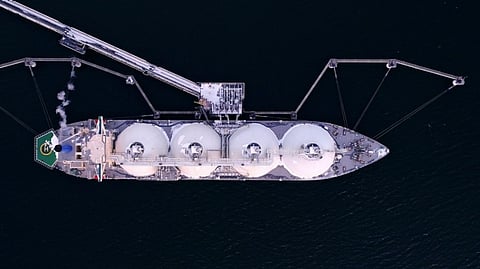


Four liquefied natural gas (LNG) vessels were sailing to China from the US and expected to arrive in June, according to data from financial firm LSEG, marking the first US LNG cargoes to leave the US and go directly to China during US President Donald Trump's second term in office.
Last week, Trump went to Beijing for a summit with Chinese President Xi Jinping. During the trip, Trump told Fox News on May 14 that China wants to buy oil, LNG and other goods from the US.
In years past, China, the world's biggest gas importer, bought lots of LNG from the US, the world's biggest gas producer, consumer and exporter.
China, however, still applies a 25 per cent tariff on US LNG following earlier levies imposed by the US on Chinese goods, which remains the biggest obstacle to a revival of LNG trade between the two countries, according to a May 12 factbox from Reuters and a May 15 report from data and analytics firm SP Global.
With global gas prices rising due to the war in Iran and four vessels currently headed from the US to China, it is likely that at least one of those ships will actually arrive in China.
The Umm Al Hanaya vessel left Cheniere Energy's Sabine Pass export plant in Louisiana on May 5, while the Id'Asah, Al Sene and Lamail vessels left Venture Global's Plaquemines plant also in Louisiana between May 8 and 18, according to LSEG data.
All four vessels were expected to arrive in China's Tianjin port between June 15 and 28. Cheniere and Venture Global are the biggest and second-biggest US LNG producers, respectively.
The US became the world's biggest LNG exporter in 2023, surpassing Australia and Qatar, as surging global prices fed demand for more low-cost US gas.
Global gas prices have spiked in recent years due to supply disruptions linked to Russia's 2022 invasion of Ukraine and the 2026 war in Iran.
In response to US and Israeli bombings, Iran effectively shut the Strait of Hormuz and attacked Qatar's LNG export facilities, knocking out about 10 billion cubic feet per day (bcfd) or around 20 per cent of the world's LNG supplies. For comparison, the US can turn about 19 bcfd of gas into LNG.
Around the world, gas traded at a six-week high near $17 per million British thermal units (mmBtu) at the Dutch Title Transfer Facility (TTF) benchmark in Europe and a four-week high near $19 at the Japan-Korea Marker (JKM) benchmark in Asia.
Gas is much cheaper in the US, which produces all the fuel it needs to meet domestic and export demand. Futures prices at the Henry Hub benchmark in Louisiana were trading around a seven-week high of around $3 per mmBtu.
(Reporting by Scott DiSavino, Editing by Nick Zieminski)
