VESSEL REVIEW | Nurai & Ivy Cove – New 93,000-cbm ammonia carriers for AW Shipping and EPS
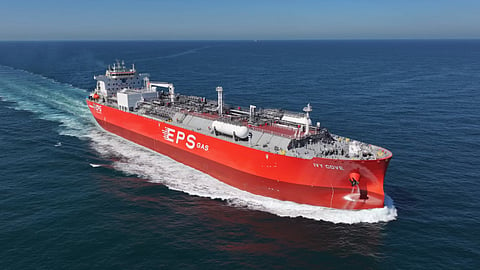
China's Jiangnan Shipyard has delivered the very large ammonia carrier (VLAC) Nurai to UAE-based AW Shipping, a joint venture formed by ADNOC Logistics and Services (ADNOC L&S) and the Wanhua Chemical Group.
Nurai is the second of four 93,000-cubic-metre (20-million-gallon) VLACs that AW Shipping has ordered from the yard. The lead ship of that design, Ivy Cove, was named and delivered to Singapore's Eastern Pacific Shipping (EPS) on June 10, and entered a charter with Trafigura.
Both Nurai and Ivy Cove are derivatives of Jiangnan's fourth-generation very large gas carrier design. It was developed for long-distance ammonia transport but can also load full cargoes of propane, butane, and other LPG products. The ships, both Liberian-flagged, can carry two grades of liquefied gas at once, which Jiangnan linked to the relatively small parcel sizes common in the bulk ammonia trade.
Cargo containment reinforced against corrosion

Lloyd's Register listed each ship as having an LOA of 229.165 metres (751.854 feet), a length between perpendiculars of 225.14 metres (738.65 feet), a moulded beam of 36.5 metres (120 feet), a moulded depth of 22.5 metres (73.8 feet), and a maximum draught of 13.047 metres (42.805 feet).
Gross tonnage is 55,645, net tonnage is 21,891, and deadweight is 66,615.
The class notation covers a Ship Type 2G liquefied gas carrier with independent Type A tanks. It approves the ships for anhydrous ammonia, all butane isomers, butane-propane mixtures, propane and propylene, with a maximum specific gravity of 0.69, a maximum vapour pressure of 0.0275 MPa and a minimum cargo temperature of -52°C.
Jiangnan Shipyard said it reinforced the four cargo tanks because anhydrous ammonia is denser than conventional LPG and required greater tank strength. At the same time, ammonia's corrosive properties restricted the yield strength of the steel that could be used.
Fitted with efficiency-enhancing and emissions-reducing features
Heavier cargo and heavier tank structure both added to the ship's weight. The yard controlled the weight increase through structural design and weight optimisation, so that all four tanks could be lifted aboard as complete units.
The low-resistance hull form was developed in-house to perform consistently in full-load and ballast conditions and with cargoes of different specific gravities. Development included resistance and wake optimisation for a medium-to-high-speed hull with a high block coefficient.
Jiangnan Shipyard also used its patented wave damping and seakeeping hull technology and fitted energy-saving devices ahead of and behind the propeller.
The ships each have an LPG dual-fuel main engine and a shaft generator, with space and an interface reserved for later conversion to ammonia propulsion. The builder said the configuration can cut CO2 emissions by about 20 per cent and SOx emissions by 99 per cent, and meets EEDI Phase III requirements.
The machinery notation indicates inclusion of a ballast water treatment system, a selective catalytic reduction system, and low-flashpoint fuel provisions.
AW Shipping contracted its first two VLACs in July 2024 for about US$250 million, alongside nine 99,000-cubic-metre (22-million-gallon) very large ethane carriers. It exercised options for two more worth US$250 million on October 10, 2024.
Captain Abdulkareem Al Masabi, then chairman of AW Shipping and CEO of ADNOC L&S, said the newbuilding contracts were in anticipation of, “future demand for lower-carbon energy sources such as ammonia, which are increasingly vital in powering the energy transition.”
The last two AW Shipping vessels are scheduled for delivery in 2027 and 2028.