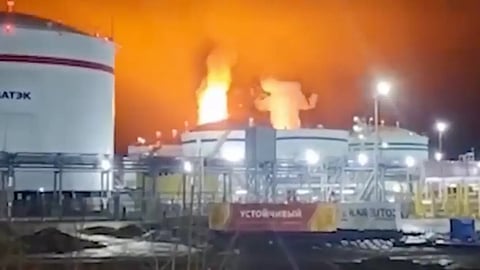


Oil and LNG shipments from Russia's Baltic export hubs of Primorsk and Ust-Luga were at a halt on Wednesday, more than a week after Ukrainian drone attacks on them began, Finland's Border Guard, which monitors the region's marine traffic, said.
Smoke was visible from Finland after Ukrainian drone attacks caused fires at Russia's Baltic ports, leading to the suspension last Wednesday of fuel loadings. The attacks have continued and Ust-Luga was hit for the fifth time in 10 days on Tuesday.
"At the moment, very few tankers are departing from the oil ports of Primorsk and Ust-Luga. We are talking about individual vessels," Head of Maritime Safety and Security at the Finnish Border Guard Mikko Hirvi told Reuters.
In recent years, an average of 40 to 50 tankers transporting Russian oil and liquefied natural gas have sailed via the Baltic Sea each week.
The shutdown is the most severe oil supply disruption in the modern history of Russia, the world's second largest oil exporter.
On Wednesday last week, at least 40 per cent of Russia's oil export capacity was at a halt, according to Reuters calculations that included the Baltic ports as well as the Druzhba pipeline, which was damaged by Russian strikes at the end of January.
For Moscow, the impact is to limit the boost in crude revenues it would have received as a result of the Iran war that has caused unprecedented disruption of oil shipments and drove a record monthly gain in international Brent crude.
Laura Solanko, Bank of Finland Senior Adviser and specialist in Russian energy markets, said that at the start of the year, the price of crude at Primorsk, excluding shipping costs, was $25 below the Brent benchmark.
"If the discount has remained at a similar level, the export price of crude oil could be around $70–75 a barrel," she said, meaning Russia would be losing more than 70 million to 75 million dollars a day from the halt of Baltic Sea crude oil exports alone. That excluded oil products which sell at a higher price.
She said that before the Ukraine drone attacks, Russia exported more than two million barrels a day of oil and oil products via the Baltic.
(Reporting by Anne Kauranen in Helsinki; editing by Barbara Lewis)
