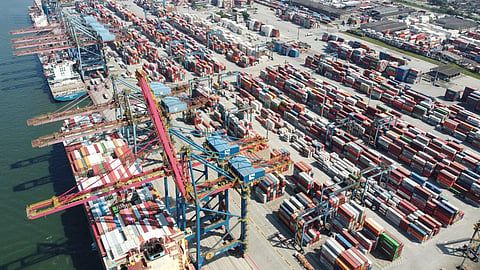
Brazilian terminal operator Santos Brasil has submitted a BRL3.5 billion ($635.3 million) investment proposal to the Santos Port Authority (APS). The plan would raise annual capacity at its Tecon Santos container terminal from three million to four million TEU by 2030.
The company announced the proposal on November 9. Implementation depends on regulatory approval and on moving its vehicle terminal (TEV) into the adjacent, federally owned Prainha area. It also requires a 25-year early extension of the TEV concession, which expires in 2035.
The works include a 400-metre container quay extension and 200,000 square metres of additional yard. A new rail yard could handle complete 1,600-metre trains, while reducing container unloading time from 12 hours to three. For TEV, the plan includes a 190-metre quay extension and capacity for 360,000 vehicles annually.
Santos Brasil expects to handle 2.9 million TEU in 2026. An earlier investment cycle of about BRL3 billion, launched in 2019 to reach three million TEU, has absorbed more than BRL2.5 billion so far.
A public hearing is expected on November 24, followed by reviews by the National Waterway Transportation Agency (Antaq) and the Federal Court of Accounts (TCU).
Sepúlveda expects the administrative process to finish by mid-2027. Licensing would take a further year, with construction beginning in 2028 and phased operation in 2029–2030.
Funding is expected to come primarily from the company's cash flow, supplemented if necessary by infrastructure debentures. Santos Brasil is wholly controlled by CMA CGM.
At the same port, DP World is separately expanding its terminal to 2.1 million TEU by 2028.
