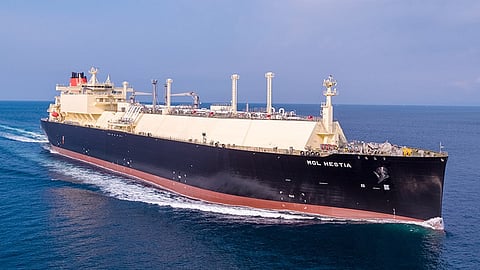


Japan's Mitsui OSK Lines (MOL) said on Friday three of its vessels that transited the Strait of Hormuz and exited the Persian Gulf in April did not pay transit fees, sticking to a principle of navigation under international law.
Tehran has proposed fees or tolls on vessels passing through the strait, in its proposals to end the war with Israel and the United States.
The strait is one of the world's most strategically vital maritime routes, with about a fifth of global seaborne crude oil and LNG flows passing through it in normal times.
The company does not intend to pay such fees in future, a company spokesperson told Reuters.
"This is a principle of navigation based on international law, and we are adhering to it," MOL President Jotaro Tamura told Reuters in an April interview, when queried if the company would pay such transit fees.
Asked how the vessels were able to pass through the strait, MOL, which still has several ships remaining in the gulf, credited the efforts of relevant countries and stakeholders.
"We will continue to prioritise the safety of our crew, vessels and cargo above all else," the spokesperson added on Friday.
Among MOL-linked tankers, a Panama-flagged liquefied natural gas (LNG) carrier, jointly owned with an Omani firm, transited the strait in April, the first such passage since the Iran crisis escalated.
Two Indian-flagged liquefied petroleum gas (LPG) carriers owned by an affiliated company have also crossed since.
Any shipper paying tolls to Iran for passage through the strait is at risk of punitive sanctions, the US Treasury warned this month.
(Reporting by Kentaro Okasaka; Writing by Yuka Obayashi; Editing by Clarence Fernandez)
