Mitsubishi Heavy Industries has released details of a new system that it has developed to enhance the damage stability of ships, reducing the risk of capsize.
The company has already received an order for the RoRo ship equipped with the new system from Nippon Shipping. Mitsubishi proprietarily developed the system in response to the strengthening of regulations on ship stability during navigation in January 2009, based on revisions to the International Convention for the Safety of Life at Sea (SOLAS Convention). Mitsubishi plans to focus its marketing activities on attracting orders for high-end ships equipped with the new system.
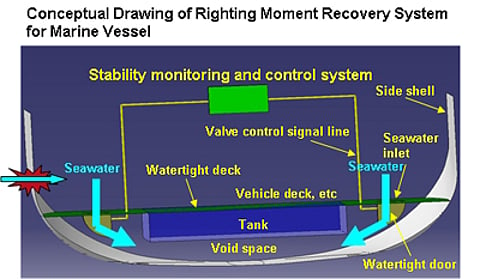
Mitsubishi is targeting installation of its newly patented righting moment recovery system on new RoRo ships, pure car and truck carriers (PCTCs) and ferries. With such ships in mind, Mitsubishi developed the system with an emphasis on low cost. If a ship's hull is damaged during navigation, the new system enables prompt conveyance of any flooded seawater into void spaces in the ship's bottom, thereby reducing capsizing risk through enhancement of righting momentum by quickly lowering the ship's centre of gravity.
Mitsubishi's system secures the void spaces near the ship's bottom by making use of spaces allocated to other functions, such as fin stabiliser rooms, duct keels and ballast water tanks. Holes and watertight covers are provided to feed the seawater into the void spaces, and pipes are in place to serve as air vents. Together the system enables prompt water filling and lowering of the gravity centre to cope with emergencies such as damage to the ship's hull. The system not only eliminates the need to divide the vehicle deck area into small compartments but also facilitates smoother vehicle manoeuvring within the ship. In this way, no vehicle-carrying capacity is sacrificed as a result of the strengthened regulations.
The 170-metre-long RoRo ship on order is capable of travelling at a speed of 23 knots, carrying about 170 trailer chassis and 100 cars. The ship consumes approximately 10 percent less fuel than existing RoRo ships in the same class. It will be built at Mitsubishi's Shimonoseki Shipyard. Delivery is slated for March 2013.

