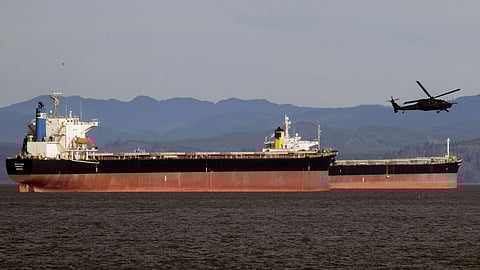


If there is one lesson that the current warfare in the Middle East has reinforced, as all the earlier crises evidently have not, is the need to be rather more self-sufficient.
The financial crisis, the Ukraine energy shock, Covid, even a blooming grounded ship blocking up the Suez Canal for a few days and the Houthi offensive in the Red Sea all underlined, in capital letters, the fragility of our supply chains.
This latest interruption, which has interposed itself into everything from energy products to agricultural necessities, surely ought to register as something more fundamental – a hard lesson we can no longer ignore, in the hope that it will resolve itself.
Our logistics in the developed world are brilliant, making the world into a market place and providing for instant gratification, except when they don’t, and sadly they fail to deliver rather too often in an unstable world.
The wonder of our delivery systems has led people to believe (encouraged by the number crunchers who sadly fail to understand geo-political issues) that stocks and spares are costs that are no longer essential.
Countries that were once the workshops of the world have “offshored” everything they once were capable of making themselves, and have become, almost without realising it, completely dependent on others for everything.
In a way, as long as there was a level of peace and stability, it didn’t matter that much, as we fortified ourselves with the beliefs that we had become a “service” economy and that life as a shelf-stacker in an Amazon warehouse was as fulfilling as working a blast furnace.
But we should have realised by now, before the missiles and drones started whizzing around, that we had become more vulnerable to world events than ever before, and that there was a case for both a more balanced economy and a great degree of self-sufficiency.
There have been plenty of warning signals about the way in which previously advanced nations had become dangerously dependent on others.
There have been little signs, like the shutting down of the only UK firm capable of manufacturing (of all things) carbon dioxide, and the government, now, panic-stricken, opening it up again as a state-owned enterprise.
The revelation that the UK carried just two days' reserves of gas, as the confidence that it would all be available from some foreign supplier, suddenly was called into doubt. The vulnerability of pipelines, cables and electricity inter-connectors has gradually registered, although not as much as it ought to have done, after a few chaps on a yacht had allegedly done for the Nordstream pipeline, and some dirty deeds with anchors.
You would not, in view of world events, seem to have been terribly prudent in closing down oil refineries all over the developed world, leaving it to others in often unstable places and fleets of tankers to keep the vital tanks of refined products topped up.
You wonder if, in all those places where they are being urged to ration fuel and drive on alternate days, the wisdom of these accountancy-led closures might now be questioned.
Gradually, the wisdom of this dependency on others might at last be disputed more forcefully, perhaps nowhere as much as in the vital issue of defence, where the patience of the US paymasters (or at least its President) appears to have finally run out.
The cost of being the world’s policeman, with the rest of the NATO members preferring to spend their money on other less martial priorities, has finally registered with a US administration unprepared to maintain the status quo.
The fact that this has coincided with the most dangerous period of global instability, has merely underlined the huge vulnerability of countries that can no longer crouch under the shelter of the US eagle’s wings, but must fend for themselves.
It would be unwise to assume that with the eventual passing of the Trump regime, what had become normal relations will be resumed. The wilful dependency of those countries that fail to spend an adequate share on defence has registered with the US public in general and will no longer be tolerated, even if a more diplomatic US administration inherits.
It would be wise, in every respect, to consider that geo-political instability has become the norm and that securing of the logistic chain should become the most important measure of good government.
