
China's Ningbo Ocean Shipping (NBOS) recorded a 9.28 per cent fall in its net profit in the first half of 2026 as higher charter and bunker costs outweighed growth in container volumes.
Net profit attributable to shareholders fell to CNY342.63 million (US$51.05 million) in the six months to June 30, from CNY377.66 million (US$56.27 million) a year earlier, according to the company’s unaudited interim report.
Operating revenue increased 17.66 per cent to CNY3.445 billion (US$510 million) as business volumes grew. Operating costs rose faster, climbing 19.73 per cent to CNY2.886 billion (US$430 million). Charter and bunker expenses contributed to the pressure on profit.
Total profit before tax declined 7.66 per cent to CNY460.2 million (US$68.57 million). Net profit excluding non-recurring items fell 6.83 per cent to CNY318.87 million (US$47.51 million), while basic earnings per share decreased from CNY0.29 to CNY0.26.
Financial expenses were CNY31.58 million (US$4.71 million), compared with a net financial gain of CNY11.04 million (US$1.64 million) in H1 2025. The company attributed the change mainly to higher foreign exchange losses.
Net cash generated from operating activities fell 9.33 per cent to CNY952.01 million (US$141.85 million). NBOS said the decline was mainly due to lower tax refunds.
Container transport volume rose 21 per cent to 3.772 million TEUs. Feeder services handled 2.646 million TEUs, an increase of 26.9 per cent, while near- and cross-ocean volumes climbed 27.8 per cent to 528,000 TEUs. Domestic container volume declined 3.2 per cent to 598,000 TEUs.
The company said international container freight rates came under pressure during the first quarter before recovering in the second quarter as seasonal stocking demand strengthened and geopolitical diversions reduced effective capacity. The average China containerised freight index was 0.07 per cent lower year on year.
Domestic rates weakened more sharply, with the average domestic container freight index down about 5.40 per cent. NBOS attributed the decline to the seasonal lull and additional capacity entering service.
At the end of June, NBOS operated 109 containerships and 10 dry bulk vessels. Its 43-route container network served 53 ports in China and overseas, with an average of 140 sailings per week.
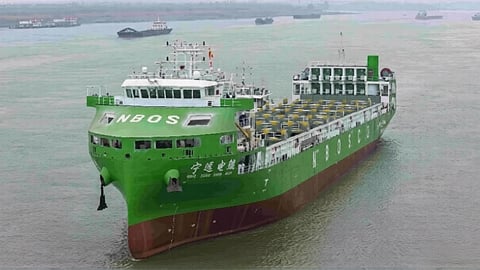
The electric containerships Ningyuan Dian Kun (pictured) and Ningyuan Dian Peng entered commercial service in April and June, respectively.
The 740TEU Ningyuan Dian Kun operates feeder services for the Port of Ningbo-Zhoushan, as detailed in earlier coverage of the vessel.

