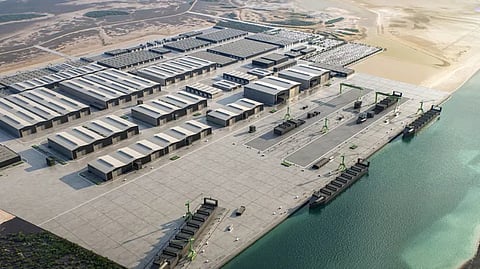

Saronic broke ground on its Port Alpha shipyard at the Port of Brownsville in Texas on September 30.
The company said the project represents more than $3 billion in private investment. The initial 835-acre (338-hectare) site has options for expansion to nearly 4,400 acres (1,781 hectares).
Saronic says the yard will initially have annual capacity of 150,000 GT, with the potential to grow beyond two million GT. Commercial and defence customers will be served by the facility. The shipyard is scheduled to open in 2028.
“Port Alpha is designed from the ground up to produce both autonomous and manned vessels at scale, with modularity and throughput shaping the shipyard’s architecture,” Saronic co-founder and chief executive Dino Mavrookas said at the ceremony.
The first phase is planned to produce ships up to 850 feet (259 metres) long; later expansion may accommodate vessels longer than 1,200 feet (366 metres).
Plans call for 1.2 million square feet (111,500 square metres) of enclosed production space, within a 2.5-million-square-foot (232,300-square-metre) area designated for production activity, spread across eight to 10 buildings.
The first phase will also have more than 2,500 feet (762 metres) of deepwater quay and two to four final ship-erection positions. Annual steel-processing capacity is projected at 75,000 tonnes.
Landing craft utility (LCU) vessels for the US Navy are expected to be among the first builds. The navy awarded prototype agreements to Saronic and two other shipyards for LCU 1700-class craft. Each yard is to build two or three prototypes and refine manufacturing plans for higher-rate production.
Saronic expects LCU production at Brownsville to begin in 2028, with first deliveries in 2029. The LCU 1700 class will replace LCU 1610 craft averaging more than 50 years of active service.

