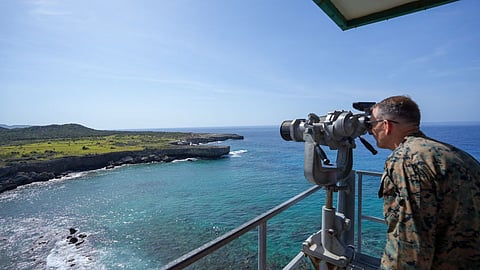


The top US general overseeing forces in Latin America held a rare meeting on Friday with senior Cuban military officials at the perimeter of US Naval Station Guantanamo Bay, Cuba, the US military said on Friday, confirming a Reuters story.
US General Francis Donovan, head of US Southern Command, briefly discussed operational security matters with the Cuban delegation, which included Cuban General Roberto Legra Sotolongo, First Deputy Minister of the Chief of the General Staff, US Southern Command said on social media.
"Donovan also led a perimeter security assessment of the naval base and discussed force protection, safety of service members and their families, and operational readiness with base officials," it said.
Donovan's meeting in Cuba is the first in recent memory by a head of Southern Command and comes amid growing concerns in Cuba of a possible US military attack on the Communist-run island.
Cuba's armed forces said on Facebook that the meeting took place with mutual agreement and that both sides agreed to maintain communication.
"Both delegations evaluate positively the meeting where issues related to security around the dividing perimeter of the military enclave were addressed and agreed to maintain communication between both military commands," the statement said.
The meeting follows a rare visit earlier in May by CIA Director John Ratcliffe to Havana.
President Donald Trump has often cited Cuba among the foreign policy goals of his second term and has hinted it will become his focus once the war with Iran is over.
Cuba has been a US antagonist for decades, since Fidel Castro's 1959 revolution.
Trump is strongly supported by hardline Cuban Americans in Florida, who have pushed for US-instigated regime change for decades, and his administration has been steadily ramping up pressure on the island.
On May 20, the US formally charged former President Raul Castro with four counts of murder for the 1996 downing of civilian aircraft operated by Miami-based exiles.
The indictment was the latest example of the Trump administration's efforts to assert US influence in the Western Hemisphere.
Washington's more assertive role in Latin America was epitomized by an audacious raid by the US military on January 3 to capture Venezuela's illegitimate president Nicolas Maduro in Caracas, and then fly him to New York to face drug trafficking charges.
Maduro, a socialist aligned with Havana, pleaded not guilty.
US Secretary of State Marco Rubio, the son of Cuban immigrants who is seen as a possible contender for the 2028 Republican nomination for president, has raised alarm in Havana by talking about the national security risk posed by what he calls a failed state just 90 miles (145 kilometres) from Florida.
On May 5, Rubio and Donovan posed in front of a map of Cuba in a post on social media by Donovan's Southern Command. It said the talks focused on, "US efforts to counter threats that undermine security, stability and democracy in our hemisphere."
Cuba's Foreign Minister Bruno Rodriguez has threatened that any military action would lead to a "bloodbath" in which thousands of Cubans and Americans would die.
Trump has effectively imposed a fuel blockade on the island by threatening tariffs on countries supplying it with fuel, igniting seemingly endless power outages and delivering new blows to the island's already ailing economy.
Experts say instability in Cuba threatens a migration crisis.
(Reporting by Phil Stewart; additional reporting by Costas Pitas and Kylie Madry; Editing by Franklin Paul, Rod Nickel)
