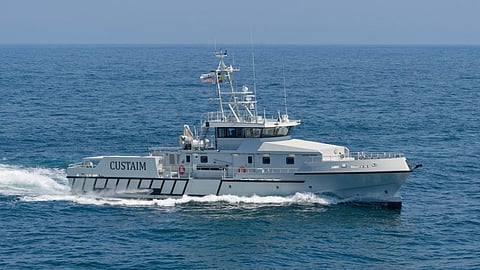

This new hybrid patrol boat from Spanish shipyard Armon was built for customs enforcement, counter-drug patrols, surveillance, and search-and-rescue operations along Ireland’s extensive 3,200-kilometre coastline.
The hybrid diesel-electric propulsion system is integrated with a high-capacity gyrostabiliser — the first time such a system has been fitted to a patrol vessel of this size. In fully electric mode, the vessel can operate silently at nine knots, ideal for discreet surveillance missions while significantly reducing fuel consumption and emissions.
The vessel excels in rough North Atlantic conditions, remaining operational in up to Beaufort Force seven winds and six-metre seas. Key operational features include a stern ramp for rapid launch and recovery of a 6.25-metre RIB, a dedicated UAV landing platform, removable rescue decks on the side passageways, and a powerful wireless remote-controlled deck crane.
RCC Cosaint delivers enhanced capability, crew comfort, and environmental performance for Ireland’s maritime enforcement needs.

"The vessel was designed to deliver highly effective manoeuvrability and responsiveness," Rosa Maria Manjon, Project Manager and Naval Architect at Armon, told Baird Maritime. "It is a highly efficient vessel in which fuel consumption has been significantly reduced, providing performance that makes it one of the best in its class. Of particular note is the installation of a gyroscope system that reduces vessel motion, offering an improved level of comfort for the crew."
In Manjon's view, the challenges faced by the company during construction were varied in nature, including the integration of different systems and the automation of power generation.
"Each vessel or craft of this type presents distinct challenges, as the design is tailor-made to meet the specific requirements of our client. As in all projects, we have learned valuable lessons that enable us to continue improving day by day."
Cosaint is a hybrid vessel, thus making her an indication of the sustainability that is one of the main attributes of the evolving Spanish and European workboat industries, as observed by Armon's Group Commercial Director Ricardo Garcia.
"I think those industries are entering a phase of transformation rather than simple growth," Garcia said. "Over the coming years, I expect three major trends to shape the market. First, sustainability will continue to move from a 'nice to have' feature to a contractual requirement in vessels. Hybrid propulsion, alternative fuels, energy-efficient hull forms, and emissions-reduction technologies will be central to newbuild and refit decisions."
Digitalisation will also play an increasingly important role not only in vessel operations, but also in design, construction, and after-sales support, as clients are demanding smarter, more connected vessels with improved monitoring, safety, and maintenance capabilities.
"Third, flexibility and specialisation will be key," he told Baird Maritime. "Standard vessels will give way to highly tailored solutions designed for specific missions, often in challenging environments."
Garcia believes Spain and even Europe as a whole are well positioned to take advantage of the transformation by relying on engineering, quality, and regulatory compliance instead of sheer production volume.
"Shipyards that invest in people, technology, and long-term partnerships will continue to be competitive and relevant in the years ahead."
For a list of the 2025 "Best Of" award winners, please click here.

