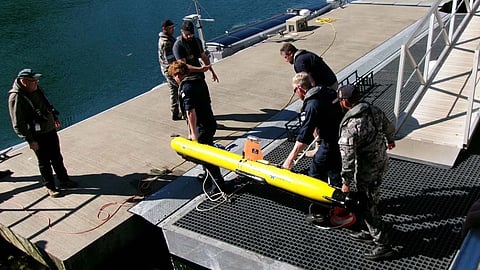

The navies of Britain, Australia and the United States recently conducted a joint exercise to demonstrate how the three AUKUS allies could protect critical undersea infrastructure using unmanned systems.
Split between Virginia and Washington in the US and waters off the southwestern coast of Australia over six weeks, Exercise Lanternfish saw Royal Navy divers and hydrographic experts run out remotely-operated systems alongside their US Navy and Royal Australian Navy counterparts.
A team from the Royal Navy Diving and Threat Exploitation Group demonstrated a small remotely-operated submersible used to locate mines and underwater explosive devices while experts from the Hydrographic Exploitation Group based in Devonport, launched their autonomous underwater vehicle (AUV). Thanks to its modular design, the AUV can carry out varied AUKUS missions depending on its sensor fit.
The Royal Navy said the systems were used to carry out surveillance of critical undersea infrastructure and to rehearse responses to potential hostile activity in a realistic operational setting, operating as part of a wider "ecosystem" of sensors and underwater vehicles to give greater understanding of the subsea environment.
The goal was to improve how nations detect, monitor and respond to potential threats below the surface, allowing participants to share expertise, collaborate and develop common operating procedures to ensure the three nations can work seamlessly together be it in peacetime or conflict.
The exercise was conducted under the AUKUS pillar II trilateral defence agreement, which concentrates on collaborative, accelerated deployment of advanced military capabilities by the three partner nations.

