
Many policymakers and industry pundits have read Arthur Herman’s Freedom’s Forge with the wrong lesson in mind.
For those unfamiliar, the synopsis is simple: in 1940, the United States mobilised its industrial base to mass-produce tanks, planes and ships at unprecedented speed. But that miracle wasn’t magic. It relied on a deep manufacturing ecosystem that already existed.
When President Franklin Roosevelt asked General Motors to build bombers and Kaiser Shipyards to churn out Liberty ships, the factories were already in place. The people were trained; the infrastructure was ready.
Australia doesn’t have that luxury. We can’t just pivot to large-scale military production: shipyards in Henderson and Osborne are already at capacity and will remain that way for decades.
The next wave of defence capability won’t come from centralising scale. It will come from distributing it, from unlocking the industrial depth that already exists across Australia’s recreational, commercial and civil maritime sectors.
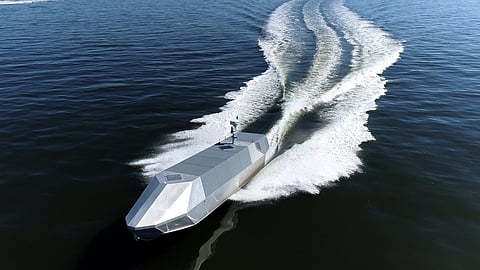
That’s the real lesson behind the Sea Archer, an 11.3-metre, multi-role uncrewed surface vessel developed by Leidos and on display at the Indo Pacific 2025 International Maritime Exposition in Sydney in early November.
It uses the same autonomy system as the US Navy’s Sea Hunter, which set the benchmark for large-displacement autonomous operations and completed a trans-Pacific voyage from San Diego to Sydney in 2023.
Sea Archer is modular, affordable and designed for multi-mission roles: intelligence, surveillance and reconnaissance; logistics; and the collaborative operation of crewed and uncrewed systems. But what makes it most relevant to Australia is the delivery mindset: small, smart, many.
The goal was straightforward: to create some vessels, building them economically and keeping the design simple enough that they could be fabricated, repaired and evolved in ordinary facilities. The challenge was whether the boats could be fixed in a decent shipyard using off-the-shelf materials and standard tools. That’s a mindset shift Australia could adopt right now.
This kind of domestic capacity is how you build redundancy.
Maritime autonomy depends on much more than underlying software such as the control logic or algorithms. Diesel engines, filtration systems, fuel delivery and remote diagnostics all matter too. Most of these components weren’t designed to run continuously without human attention, so turning a crewed vessel into an autonomous one is an industrial challenge.
That’s why we should stop thinking of autonomous surface vessels as specialised defence platforms. The right design is closer to a truck than a warship: these vessels are built to carry people, surveillance equipment or, in the future, munitions. They should be cheap enough to lose, flexible enough to upgrade and sturdy enough to operate without bespoke support.
While they won’t replace destroyers, they’ll extend the fleet, supporting operations by giving commanders more tools to adapt in-theatre.
Australia can build this, and indeed already does. The industrial base already exists, constructing, for example, aluminium catamarans in Hobart and high-performance craft on the Gold Coast. What’s missing is the connection to defence. A sovereign maritime autonomy program could draw from that distributed capacity rather than compete with it.
Rather than centralised production, think edge manufacturing—production close to where the vessels are built, operated and maintained. The goal isn’t to stand up another Osborne but to activate a network of fabrication sites able to produce, maintain and evolve a fleet of robust, utility-class autonomous systems.
This is also a chance to get ahead of the regulatory curve. Autonomy at sea raises legitimate legal and operational questions. Is the vessel registered as a civilian craft, a government or naval vessel, or something in between, and under which national authority does it operate?
What does meaningful autonomy look like under international maritime law, and how should uncrewed vessels be classified and authorised to operate? While these questions won’t stop innovation, they do need answers.
Outside of a full-scale conflict, any autonomous system deployed in peacetime needs to operate within those rules. That means building platforms now, fielding them, and learning how to manage their lifecycle.
Much of our thinking on military innovation is shaped by recent conflict, including littoral operations in the Persian Gulf and drone warfare in the Black Sea. But Australia’s problem set is different. Our northern approaches are vast; the operational geography resembles the Atlantic more than the Persian Gulf.
In a drawn-out Indo-Pacific conflict, with both sides evolving their tactics, we’ll need persistence, adaptability and the ability to push capability forward. Autonomy offers that potential, if we treat it as something we can scale.
That means building platforms we can produce, repair and iterate quickly. Not unicorn projects, but widely used equipment. The Sea Archer proves that this approach works, and there should be more like it.
The same mindset could apply to aerial systems. Australia’s other autonomy programs, such as Boeing’s MQ-28 Ghost Bat, have shown what happens when complexity outpaces delivery.
The need for high specifications in projects such as that one—for example, matching speeds with crewed aircraft or delivering sufficient range—shouldn’t hold back development of simpler, modular, attritable systems that can be fielded faster. Maritime autonomy gives us a second chance to get the foundations right and build a model that scales across domains.
If Australia wants to lead in autonomous systems, we should start by building the vessels we already know how to make: smaller, cheaper, simpler if necessary, but ready. Because the goal isn’t just smarter autonomy but better capability. Especially in this region, getting good at building boats matters.
Article reprinted with permission from the Australian Strategic Policy Institute's analysis and commentary site The Strategist.

