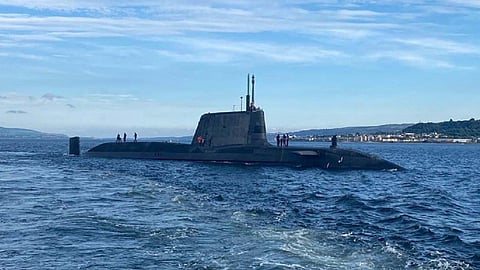

The Royal Navy’s first contribution to Submarine Rotational Force-West (SRF-W) is on its way to the southern hemisphere. The submarine HMS Anson will join SRF-W at HMAS Stirling in Western Australia, marking an important stage in Australia’s optimal pathway to obtaining its own nuclear-powered submarine capability.
Keen AUKUS-watchers might recall the announcement made in 2022 that Australian sailors would train aboard Anson.
For a significant AUKUS milestone, there has been remarkably little discussion of this deployment to date. Why is this?
The UK emphasises the importance of AUKUS in much the same way that Australia does – job creation, enhancing its own and international security, and contributing to a “free and open Indo-Pacific”.
Moreover, the relationship with Britain is one of Australia’s warmest. Where Australia worries about its relationship with Washington, given questions about American reliability and its domestic issues, its relationship with London remains a comforting constant.
But is this comfort part of the problem?
While it only forms one element, AUKUS has become a shibboleth for the totality of Australia’s American alliance. Perceived impediments to the arrangement, particularly relating to the future of the Virginia-class SSNs Australia is set to acquire, are cast as threats to the integrity of the alliance, while milestones are heralded as examples of the alliance’s strength.
The British shipbuilding industry is also in rough shape, with uneven procurement practices affecting its productivity, but in the Australian conversation, these British issues are given short shrift compared to American ones.
It is American submarines, therefore, and not the British-designed SSN-AUKUS, which dominate the Australian debate. Even when talking about, for instance, collaboration on autonomous systems as part of AUKUS pillar II, the conversation turns to the fact that purchasing such systems from an American company is a boon to the program.
This is also due, in part, to the lacklustre justifications for the program that have hitherto been provided. Successive rounds of polling by the Lowy Institute have shown no substantive change to support for acquiring nuclear boats through AUKUS since its announcement.
While some might take this as an indication of broad approval, this information should be interpreted as a demonstration of a lack of effective communication as to why the program is necessary. Indeed, when the question was last asked in 2023, only 49 per cent believed the arrangement makes the country safer.
AUKUS was announced to the world as a fait accompli, and the Australian Government is obsessed with ensuring its first major fait can actually be accompli at all.
Within these strictures, the UK takes a back seat. This is an unfortunate situation for a country that aims to provide for Australia’s future submarine fleet. Since the beginning of the deal, Britain has felt like something of an afterthought.
This is not promising for the future of AUKUS. But it will be difficult to increase public conscience in Australia of the UK’s significance for the program for several reasons.
The first is due to the nature of the Australia-UK relationship. It is easy and comfortable, and like all such things, suffers from a lack of scrutiny because it has not required it.
A second and crucial reason is that the UK is not and will never again be Australia’s primary security partner. That space, filled by America since the Second World War, leaves little room to discuss other partners. Australia’s strategic debate more often features countries in its own region, such as Japan, Singapore, and Indonesia.
A third reason lies with Father Time. Britain’s most significant contribution to AUKUS – the future SSN – is decades away. While this is no reason not to pursue it, Australia’s strategic planning has since 2023 been operating under an assumption that it no longer possesses a ten-year warning time for possible regional conflict.
There is a tension between these timelines, which naturally leads Australia to invest more energy into securing American submarines, which under the optimal pathway are to arrive much sooner.
Finally, it is also worth mentioning that the UK has priorities of its own in the northern hemisphere. No end appears in sight for the Russian-Ukrainian War, now in its fourth year.
NATO is under extreme pressure due to both Russian aggression and the vicissitudes of the Trump administration. And far-right parties are gaining ground across Europe and the UK.
Britain’s defence procurement and submarine service itself is under pressure, prompting doubts about the future SSN. The Geelong Treaty, signed with Australia last year, was fêted as a means to change this, but has been criticised as more flourish than substance.
While a positive move for AUKUS, given the strategic situation in Europe and the UK’s own issues with its submarine fleet, the deployment of HMS Anson to the Indo-Pacific is questionable. How does the “key planning assumption” that the UK will have a permanent rotational submarine presence east of Suez square with increased pressures to preserve deterrence in Europe and the Atlantic?
It is possible that Anson’s deployment may be perceived as a proxy for NATO assertiveness, with a member undertaking a global mission even as it undertakes European ones.
But whatever the case, the UK will need to make the most of this deployment to Australia if it wants to shake the perception that it is like Catherine Earnshaw’s ghost on the moors, begging to be let in.
This story originally appeared on The Interpreter, published by the Lowy Institute for International Policy.

