VESSEL REVIEW | CAMD – Turkish mini-submarine also used as equipment testbed
Turkish company Datum Submarine Technologies has introduced a new crewed miniature submarine.
The multi-purpose mini-submarine (çok amaçlı mini denizaltı; ÇAMD) will serve as an underwater testbed for equipment destined for MILDEN, Turkey's national submarine programme. Datum has described the vessel as the first mini-submarine designed and built in Turkey.
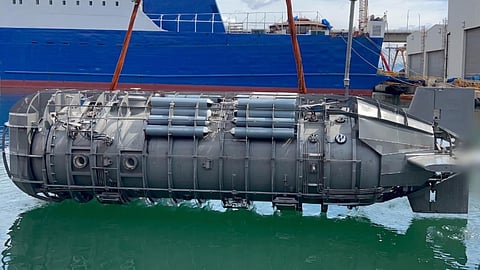
Datum Chairman Dr Münir Cansın Özden said CAMD’s first uncrewed dive, conducted in April, was a submerged functional test for classification. The boat was suspended from a floating crane and connected by cable while the team operated propulsion and steering and checked for leaks with the outer fairing removed.
"The multi-purpose mini-submarine is normally a crewed submarine," Özden said. "It can be operated by two people and can also carry two test personnel."
The two boat operators sit in the forward section facing ahead, with the two systems operators immediately behind them facing aft.
ÇAMD has an LOA of 12 metres (39 feet), a beam of 2.3 metres (7.5 feet), an overall height of 2.9 metres (9.5 feet), and a displacement of 36 tonnes. Its load-bearing pressure hull measures eight metres (26 feet) long and two metres (6.6 feet) in diameter. The hull sits inside a removable composite outer fairing that provides the hydrodynamic form.
The boat was designed for road transport, and Datum has rated it for depths beyond 300 metres (980 feet).
Propulsion is all-electric, with a 22kW drive built around a water-cooled electric motor certified by Türk Loydu and powered by a lead-acid gel battery.
Datum has quoted a maximum submerged speed of 10 knots, a cruising speed of four knots, and a range of 100 nautical miles.
Viable alternative testing platform to frontline submarines

The boat has hydraulically actuated control surfaces, main ballast tanks, separate trim and compensation tanks, and a custom electrical and control system.
The monitoring equipment meanwhile covers pressure, gases, liquid levels and fire, and the boat also carries emergency recovery equipment and a rescue buoy.
Navigation relies on GNSS while on the surface and on inertial navigation aided by a Doppler velocity log when submerged. Communications are provided by VHF and underwater acoustic systems.
Project documentation also listed a forward-looking sonar, an altimeter, a radar, and an electro-optical camera with all-round coverage.
Aselsan sonar suites and Roketsan's Orka lightweight torpedo were stated as planned integrations for ÇAMD, though neither integration was demonstrated in the April dive.
The testbed is intended to let suppliers evaluate their equipment aboard a moving underwater platform without withdrawing operational submarines from fleet duties.
"The submarine we have built is a test submarine, and what we have done here is demonstrate the technology," Özden said.
The ÇAMD project began in 2021 as research and development project backed by Turkey’s Presidency of Defence Industries and conducted under a technology acquisition obligation associated with Sefine Shipyard's DİMDEG project.
Completely designed and built in Turkey
The project’s stated aims were to validate submarine designs on a compact physical platform, build Türk Loydu's experience in submarine plan approval and certification, and give Turkish suppliers a platform for underwater testing.
In July 2023, a separate pressure hull test article measuring two metres (6.6 feet) long and 1.5 metres (4.9 feet) in diameter and fitted with representative closures and penetrations, was lowered to 400 metres (1,300 feet).
Detailed design and manufacture of the full-size pressure hull were completed in October 2023.
Yakut Kazan fabricated the pressure hull, Femsan DC Motor manufactured the motor, and Eriş Pervane produced the propeller. Sefine Shipyard completed final assembly.
Datum has reported a fully domestic design and more than 80 per cent domestic content.
The company identified ÇAMD as the first submarine project for which Türk Loydu has completed plan approval and system certification.
ÇAMD was also used as the basis of Datum's Sinarit extra-large unmanned underwater vehicle (UUV). In the latter, the crew section has been replaced with a 3.8-metre (12-foot) modular payload bay.
Armament and sensor options for the UUV will include mines, torpedoes, electro-optical systems, synthetic aperture sonar, inertial navigation systems, and one-way attack drones.