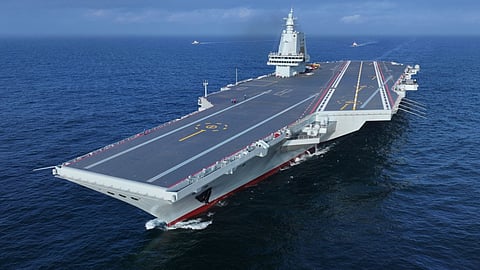


China teased in a video an aircraft carrier that could be its fourth, and the first using nuclear power, while vowing to further build up its islands, as it looks to boost maritime power, secure resources and bolster territorial claims.
The video issued on the eve of the 77th founding anniversary of the Chinese People's Liberation Army Navy featured fictional officers with names that are homophones of three commissioned aircraft carriers, the Liaoning, Shandong and Fujian.
Titled "Into the Deep", it showed a 19-year-old named "He Jian" joining the group, unleashing public speculation that it was referring to a nuclear-powered aircraft carrier, as the navy recruit's name is a homophone of "nuclear vessel" in Mandarin.
The three aircraft carriers now in service are all conventionally powered, carrying sequential pennant numbers 16, 17, and 18. The new recruit's age, 19, suggests "He Jian" will conform to the numbering convention.
China's defence ministry did not immediately respond to Reuters requests for comment on Wednesday's video.
Beijing is spending billions of dollars to build a "bluewater navy" allowing it to project power far from its shores, a goal dating from 2012, when President Xi Jinping became leader of the ruling Communist Party.
Action sequences in the video featured military drills and strikes in the Pacific. But it also sent a message to democratically-governed Taiwan, which China claims as its territory, despite Taipei's rejection of the claim.
The video showed an exchange between a naval officer and his son "Xiao Wan", the latter's name an allusion to Taiwan.
"I don't want to go home just yet. I want to play out a little longer," the boy says.
His father responds, "Xiao Wan, don't be difficult. Mum is waiting for you at home. Let's go home."
China's natural resources ministry, in an article published in the official People's Daily, urged greater efforts to "protect" the more than 11,000 islands China claims.
The vast majority of these are located within 100 kilometres of the coast, with nearly 60 per cent in the East China Sea and the rest in the South China Sea, an official tally showed in 2018.
China has built artificial islands, airstrips, and military facilities during extensive land reclamation efforts over the years in disputed waters in the South China Sea.
(Reporting by Ryan Woo and Xiuhao Chen; Editing by Clarence Fernandez)
