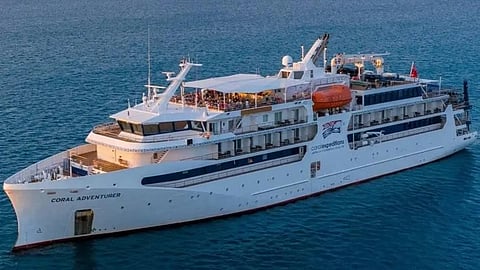

A preliminary report recently published by the Australian Transport Safety Bureau (ATSB) has outlined the order of events leading up to the grounding of the Australian-flagged cruise ship Coral Adventurer near a remote port on the north-east coast of Papua New Guinea in December 2025.
The ATSB launched a transport safety investigation after the 93-metre ship grounded on the morning (local time) of December 27, 2025, with 80 passengers and 44 crew on board.
The cruise, which had left Cairns 10 days prior, had visited several sites in PNG, with passages between them generally conducted overnight. On the morning of the accident, the ship was towards the end of one such overnight passage, from Lababia to Dregerhafen.
The planned route to enter Dregerhafen involved first turning to port, so the ship could pass south of Nussing Island, and then turning to starboard, to continue towards the harbour entrance.
During the night, the chief mate had made a small change to this route in the ship’s electronic chart display and information system (ECDIS; the ship’s digital navigation system), intending to smooth out the second turn.
At about 05:12 on December 27, as the ship approached Dregerhafen, the chief mate attempted to select this modified route in the ECDIS, but found it would not load until a "route safety check" had been performed via the ECDIS’ route editor function.
While the chief mate was addressing this issue, the ship travelled past its first waypoint for the planned turn to port.
After resolving the ECDIS issue and realising the waypoint had been missed, the chief mate switched the steering from autopilot to manual, to expedite the turn to port and quickly regain the planned track.
“During this hard manual turn, the ship slowed considerably, to 3.8 knots,” ATSB Chief Commissioner Angus Mitchell said. “The chief mate, perceiving the loss of speed was due to a strong current, increased the rpm setting of both [azimuthing] thrusters.”
At about 05:18, the ship had returned to the planned track, and the chief mate switched the steering mode back to autopilot. Speed had now increased to around eight knots, 2.5 knots higher than planned.
As the ship arrived at the wheel over point for its second turn, the chief mate altered course to starboard but the ship did not turn as quickly as anticipated, resulting in a wider than planned turn.
With the ship now travelling at 8.5 knots and roughly 200 metres west of its planned track, the chief mate switched back to manual steering and increased the rate of turn.
“At this point, in dark conditions and without navigational aids or lights ashore, the chief mate reported being unable to visually identify the surrounding topography in relation to what was being shown on the ECDIS,” Mr Mitchell explained.
The preliminary report notes the master arrived on the bridge around this time. However, the ship continued past the planned track and grounded on a reef about 160 metres east of it.
Coral Adventurer came to rest and was heeled over about six degrees to port. There were no reported injuries to those on board. The ship sustained hull indentation damage, and some structural deformation.
After initial refloating efforts were unsuccessful, all passengers were disembarked on December 30. The ship was refloated a short time later, and navigated to a safe anchorage for further assessment.
ATSB investigators attended Coral Adventurer while at anchor to collect relevant recorded data, documentary evidence, and to interview members of the ship’s crew.
Mr Mitchell said collection of other relevant evidence is being progressed, and the investigation was continuing, with analysis and findings to be developed for publication in a final report.
“As the investigation progresses, it will consider the data captured by the ship’s voyage data recorder, as well as available CCTV footage,” Mr Mitchell said. “Investigators will also analyse human factors considerations, and will review the ship and its operator’s passage planning and navigation procedures, including resource management.
“There will also be a review of the ship’s emergency response procedures, and overall safety oversight.”
Mr Mitchell said that if a critical safety issue is identified during the investigation, the ATSB would immediately notify relevant parties.
“The final report will contain analysis and findings, as well as any safety actions taken, or our recommendations for such actions to be taken,” he concluded.
The preliminary report can be read here.

