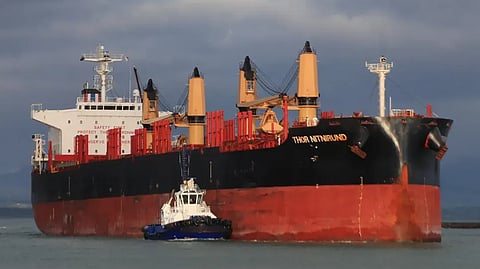
The Transport Accident Investigation Commission of New Zealand (TAIC) has published its report on the lifting mishap that had resulted in an injury on the Singapore-registered bulk carrier Thor Nitnirund on March 20, 2025.
On the said date, Thor Nitnirund was drifting in Cook Strait while waiting for a berth in Wellington.
Heavy weather in the preceding days had washed two cargo lashing chains over the ship’s side. To recover them, the crew improvised a lifting system powered by a mooring winch.
The crew hauled one chain on board. As they were hauling the second chain, a web sling anchoring the lifting system failed.
Components of the system struck an able seaman, who suffered serious head injuries and was later evacuated by helicopter.
The TAIC said the sling failed at less than half of its expected minimum breaking load because its webbing was damaged and in poor condition.
The sling was not recorded in the ship’s lifting gear register. It was likely inherited from a previous operator without being maintained or inspected under the ship’s safety management system.
The crew meanwhile did not identify the consequences of a failure under load and underestimated the risks of the improvised lifting arrangement. The task was not properly planned, risk-assessed or supervised.
The ship’s safety management system required risk assessments and toolbox meetings, but these were not applied effectively to this task, and audits by the operator did not identify the gap.
A toolbox meeting was held, but it was in the cargo office not the worksite, so the crew had less opportunity to visualise the operation, identify hazards, and consider safer ways of doing the work.
The TAIC said this accident reinforces several lessons for front-line workers, mid-managers, and senior officers carrying out lifting operations or other non-routine tasks. These lessons include: staying clear of danger zones; identifying and monitoring the risk of equipment failure as part of pre-task planning and supervision; plannig, risk-assessing, and supervising lifting operations before work begins; knowing what equipment is covered by the safety management system and ensuring it’s inspected, maintained, and documented; and active implementation of the ship’s safety management system by senior officers.
The TAIC issued no new recommendations. The operator, Thoresen and Co (Bangkok), showed that it had taken action to address the safety issues identified in this inquiry. This included stronger lifting gear inspection and maintenance procedures, unique identification of lifting equipment, colour-coding, inventory controls, and standardised fleet-wide management processes.
It also strengthened requirements for worksite toolbox meetings, task supervision, risk assessment procedures, and auditing of onboard practices.

