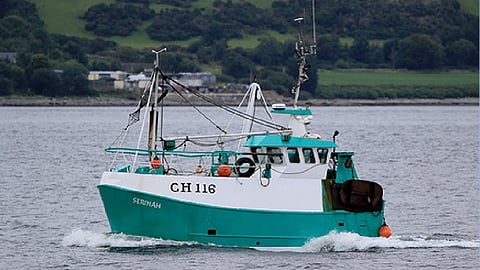
The UK's Marine Accident Investigation Branch released its findings into the April 25, 2024, collision between the crude oil tanker Apache and the stern trawler Serinah. The accident occurred in the Firth of Clyde and resulted in the fishing vessel sinking after its hull was penetrated.
The Serinah departed its home port of Troon at 08:20 for a two-day fishing trip with three crew on board. At about 13:00, the skipper decided to fish a seabed depression known as the North Hole, planning three clockwise laps of the area.
The Apache, a 159,000 DWT tanker which carried 129,000 tonnes of light crude oil, was approaching the Clydeport pilot boarding area at 14:31 at a speed of 9.2 knots (17 kilometres per hour). The vessel was bound for the Finnart Oil Terminal with the master, second officer, and a helmsman on the bridge.
The 9.9-metre Serinah was visible on the tanker's radar at a distance of 4.4 nautical miles (8.1 kilometres). On the fishing vessel, a deckhand was manually steering and could see the Apache at a distance of about five nautical miles (9.3 kilometres).
At 14:40, the Serinah began a turn to starboard while towing a single trawl at a speed of 2.7 knots (five kilometres per hour). The second officer on the Apache was aware of the fishing vessel and monitored its position visually as the distance closed to 3.5 nautical miles (6.5 kilometres).
By 15:00, the vessels were 0.8 nautical miles (1.5 kilometres) apart when the deckhand on the Serinah put the helm hard over to starboard. The Apache maintained its course and speed as the master and second officer discussed whether the fishing vessel would try to cross their bow.
At 15:02, the Apache acquired the Serinah as a radar target and sounded one long blast on the forward whistle. The collision occurred at 15:03 after the bulbous bow of the tanker ran over the trawl wires of the fishing vessel, pulling the stern under the water.
The Apache did not initially stop to render assistance to the three crew members who had entered the water after the vessel listed to starboard.
The investigation determined that neither vessel took avoiding action in accordance with international regulations to prevent the collision. The Marine Accident Investigation Branch found that assumptions were made about the intended actions of the other vessel, which led to the "very serious marine casualty".
Nereus Shipping stated it has revised watchkeeping procedures and conducted internal audits following the incident. The company was also advised to engage with a fisheries liaison officer to increase its understanding of "global fishing vessel behaviour".
The Serinah's operator, S and B Fish Agency, was recommended to, "ensure all crew expected to hold a navigational watch are sufficiently experienced and have a working knowledge of the International Regulations for Preventing Collisions at Sea, 1972, as amended." This recommendation follows findings that the deckhands on watch had not received formal navigational training.
The Maritime and Coastguard Agency stated that all skippers and watchkeepers on vessels from seven metres to 16.5 metres are expected to complete approved training. This measure is intended to ensure they are competent to hold a navigational watch in line with regulatory expectations.
In response to the incident, Peel Ports Group developed a five-year plan to upgrade the monitoring capability of the port to vessel traffic service standards. The investigation identified that Clydeport Local Port Services did not have the capability to monitor the traffic situation in the Firth of Clyde when the collision happened.
All three crew members of the Serinah were eventually rescued from a liferaft by a Royal National Lifeboat Institution lifeboat. There were no injuries reported following the medical assessment of the crew, though the fishing boat was lost.

