

US President Donald Trump said on Friday that Iran had asked to continue talks and the US had agreed, but that the June ceasefire was, "over".
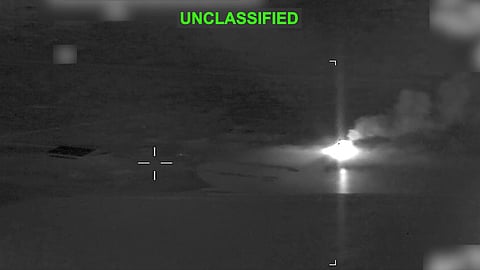
His comments came after three Qatari and Saudi commercial tankers came under fire this week, prompting the US to hit Iranian sites, and Iran to respond with strikes on US military installations in neighbouring Persian Gulf states on Thursday. No attacks were reported on Friday.
"The Islamic Republic of Iran has asked us to continue 'talks.' We have agreed to do so, but the United States has stated to them, in no uncertain terms, that the Cease Fire is OVER!" he wrote in a post on social media.
The two nations reached an interim deal last month to end a four-month conflict that has killed thousands and throttled worldwide energy supplies.
Qatari negotiators were meeting officials in Iran on Friday to seek to de-escalate tensions after the exchange of fire and to discuss navigation through the Strait of Hormuz, a source with knowledge of the situation told Reuters.
Daily tanker traffic through the critical waterway appeared to have slowed on Friday, after the series of attacks stoked concerns about the recovery of global oil supplies and shipping, and highlighted the fragility of the interim truce.
The Qatari talks in Iran aim to address the implementation of the US-Iran memorandum of understanding and the issues that triggered the recent escalation, including disputes over navigation in the strait, the source said.
Iran's semi-official Tasnim news agency said a Qatari delegation visited Iran in an effort by Doha to consolidate its role as a mediator.
Oil prices eased on Friday but remained on track for weekly gains of five per cent after the hostilities.
The Strait of Hormuz handled about a fifth of global oil supplies before the war. Tehran has since largely taken control of the waterway, forcing a stalemate in its confrontation with the world's most powerful military.
Under the interim deal, the US ended its naval blockade of Iranian ports, and Iran agreed to ensure safe passage of commercial vessels.
However, this week Washington accused Iranian forces of attacking three tankers in the area and struck military sites in Iran in response. While Iran has not claimed responsibility for those attacks, analysts say Tehran uses such actions to gain leverage in negotiations.
Iran then attacked US military sites in gulf states on Thursday.
The US said its action aimed to keep the strait open and that Iran did not control the waterway. Tehran warned however that the strait would only be reopened on its terms, and any US intervention would draw a "crushing response".
The UN shipping agency's governing council on Friday condemned efforts by Iran to impose sovereignty over the Strait of Hormuz and Tehran's "unilateral decision" to create a body to control traffic through it.
Prior to this week's attacks, daily tanker traffic had risen to its highest since the war began, averaging 40 ships transiting the strait. That was still far off the pre-conflict average of 125 to 140 daily sailings.
(Additional reporting by Jonathan Saul; writing by Alexandra Hudson; editing by Philippa Fletcher and Andrew Heavens)
