VESSEL REVIEW | Spirit of Tasmania IV & V – TT-Line Company's large dual-fuel ferries to operate on Australia's Bass Strait
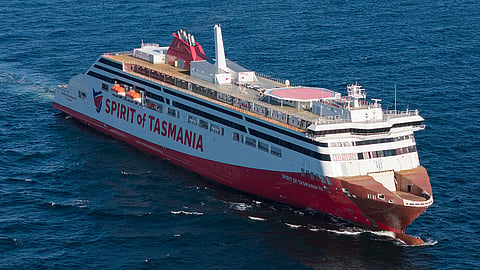
Australian ferry operator TT-Line Company began passenger operations with its two new Ro-Pax ferries, Spirit of Tasmania IV and Spirit of Tasmania V, on the Bass Strait route between Geelong, Victoria, and Devonport, Tasmania, on October 31, 2026.
The sister ships were built by Rauma Marine Constructions (RMC) in Finland to a concept design by Foreship. They have replaced Spirit of Tasmania I and Spirit of Tasmania II, which were also built in Finland and entered service in 1998. Spirit IV and V are the first newbuild ferries commissioned by TT-Line.
Each vessel has an LOA of 212.1 metres (695.9 feet), a length between perpendiculars of 192.1 metres (630.2 feet), a beam of 31 metres (100 feet), and a design draught of 7.1 metres (23 feet). The gross tonnage is approximately 48,000, and the service speed is 26 knots.
Each ship can carry 1,800 passengers in 301 cabins and lounges fitted with 118 airline-style reclining seats.
Southern hemisphere-optimised modification of an existing ferry design

TT-Line Company project technical manager John Anastassiou said that the ferries’ dimensions were set by the approach to Devonport, "which is essentially a narrow river with rapidly changing tides."
The machinery includes a sea margin so the ships can hold the timetable in heavy weather on the 242-nautical-mile passage.
Crossings take 9.5 or 11.5 hours, depending on season and schedule.
The hull design is based on that of the Tallink shuttle ferry MyStar, which RMC delivered in 2022. The Tasmanian ships have larger-area stabiliser fins and omit MyStar's high Baltic ice class.
Propulsion is provided by four nine-cylinder, dual-fuel main engines that are each rated at 10,305 kW (13,800 hp) at 600 rpm and that can run on diesel and LNG. Three auxiliary engines each deliver 1,440 kW at 1,000 rpm. The LNG fuel is held in two 400-cubic-metre (90,000-gallon) Type C tanks, and the main engines comply with IMO Tier III NOx emissions standards.
The main engines drive two controllable-pitch propellers integrated with rudders in Kongsberg Promas systems. Four Kongsberg TTC tunnel thrusters, two forward and two aft, assist in harbour manoeuvring.
At sea, two Alconza shaft generators with variable frequency drives supply the hotel load while shaft speed varies with propeller pitch. In port, the three auxiliary sets power the thrusters.
Cooling-water heat is recovered for domestic hot water while waste heat is taken from the auxiliary exhausts. Both ships can use shore power.
Built for faster turnarounds
The ships can load and unload on three levels simultaneously through MacGregor ramps and hoistable car decks, whereas their predecessors used two levels.
Deck three, the main freight deck, has extra clearance for high-cube containers on trailers. Deck five can take additional freight, with an aft weather-deck area for nine hazardous cargo trucks or trailers.
Hoistable sections on deck six can increase car capacity during peak periods. Deck seven is reserved principally for cars, motorhomes, and caravans and has 20 electric vehicle charging points.
Reefer connections and livestock ventilation are also fitted on the freight decks.
A lift forward on deck three lowers a 40-foot (12-metre) stores trailer to deck two, so stores can be unloaded without interrupting vehicle traffic.
According to the Tasmanian Government, the new ships each have capacities of 4,098 lane metres (13,440 linear feet) and 1,138 passenger beds. This compares with 2,565 lane metres (8,415 linear feet) and 750 beds in 222 cabins on the 195-metre (640-foot) predecessors.
The cabins comprise 12 deluxe cabins, two family suites, 120 outside, 159 inside and eight accessible cabins.
Eighteen cabins can accept pets, and a kennel area separate from the vehicle decks has cameras so owners can view their animals during crossings. Figura was responsible for the interior design.
The vessels also boast designated outdoor areas where passengers who are travelling with their pets can take their pets on lead if required during the journey.
Most public rooms are on deck eight.
Full range of safety systems
Survitec supplied the fire protection package, which consists of water mist systems for the machinery and accommodation spaces, deluge protection on the vehicle decks and dry powder systems at the LNG bunkering stations.
There are also two slide-based marine evacuation systems while Hatecke supplied four enclosed lifeboats.
Kongsberg also supplied the bridge equipment. The main bridge is on deck 10 while a backup bridge is on deck 11 for safe return to port compliance.
RMC delivered Spirit of Tasmania IV on September 12, 2024, and Spirit of Tasmania V on June 25, 2025.