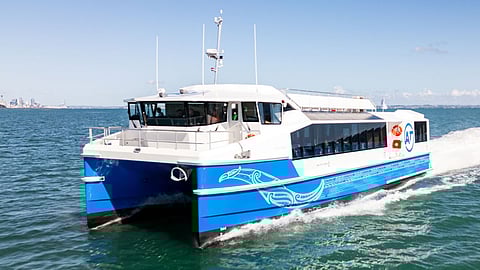


This sleek new fast ferry, designed by EV Maritime, is a high-performance, fully electric catamaran designed for inner-city commuter routes in Auckland's Waitemata Harbour.
The vessel features a lightweight CFRP hull with foam core for durability and reduced weight, with its propulsion setup resulting in a maximum trial speed of 30.4 knots and a service speed of 25 knots, with a range of up to 40 kilometres per full charge.
Taking only around 25 minutes for a full charge, or 10 minutes for a partial top-up to support quick turnarounds, this very environmentally friendly ferry is ideal for sensitive urban waters and likely represents only the first of many to come.

"We've exerted every effort to make everything about it special, from the performance and capability to the operator and customer experience," Michael Eaglen, Founder and CEO of EV Maritime, told Baird Maritime. "From all the feedback we have been receiving, I think we nailed it on all fronts."
Eaglen said that EV Maritime's status as an engineering and technology company enabled it to deliver such a specialised vessel.
"Our team’s relentless drive for efficiency has delivered a platform that is materially more efficient than status quo vessels. This has enabled us to save power and energy, over-delivering on speed and range. The result truly meets the 'zero per cent emissions, 100 per cent capable' objectives we set for the program."
Eaglen said EV Maritime started the project while recognising that the sensitivity to the power/energy/weight spiral would make a high-performance electric boat much more complex to design compared to diesel-powered vessels.
"We could see that this was a real threat to electrification in this market segment, because the cost and risk of continuing the industry’s current custom approach to projects would be untenable on all but the most generously funded projects. But of course, the first vessel of a standard platform is really just a custom boat with a larger design budget, so we went through all the challenges the we foresaw."
Eaglen explained that there were also unforeseeable challenges, such as the failure of three battery manufacturers in the course of the project.
"The cost and complexity of managing through the necessary substitutions was huge and makes it all the more remarkable that we were able to deliver on the original project vision."
The option to adopt electric propulsion for the new ferry followed a trend in naval architecture that Eaglen had identified.
"It has been reported that 70 per cent of all new ferries currently under contract have electric drivelines. Not all of these are fully electric, as many are hybrid in one form or another. And while there is less pure 'climate action' funding available at the moment, new concerns look likely to drive policy towards ongoing funding of the same types of capabilities and technologies."
He added that the growing awareness of the strategic importance of each country’s domestic maritime industry is seeing government officials looking at the future-readiness of their industrial base and seeking ways to maintain or revive global competitiveness to meet the demands of buyers in the future.
"Geopolitical tensions are also bringing the risk lens back onto national energy security and energy sovereignty. The reality is that most nations will find it easier and more cost-efficient to scale their electricity generation capacity than to scale their local fossil fuel extraction capacity. I think that both these factors will see continuing pressure on the industry to deliver high-confidence electric solutions for the commercial maritime sector."
Eaglen said that regulators are also aware of this trend, and that many are giving careful thought in redefining existing regulations for maritime electrification.
"So far, this seems to be resulting in a general convergence of regulation around the world, which has to be a good thing for supporting industry confidence to invest in technology and capability."
The delivery of the new ferry has led Eaglen to describe 2025 as a big year for EV Maritime, since it marked the introduction of the first vessel utilising the company's first ever design.
"After many years in the making, it was very satisfying to be able to deliver on the promises we made," he told Baird Maritime. "We have been busy welcoming guests from around the world to see the vessels and experience them up-close."
The previous year also saw EV Maritime significantly widen its project base. Eaglen explained that in 2024, the company had already entered into an agreement with a San Francisco Bay Area operator for the design of a new plug-in hybrid vessel, the first example of a 19-metre series. In 2025, the company took on two additional Bay Area operators as customers.
"We also took on new senior staff, which significantly expands our in-house capability, and we developed some really promising strategic partnerships that I’m very excited about," said Eaglen. "So business is good. We are growing, but at a pace that I think we can manage well and deliver confidently, which really is the perfect scenario for any business owner."
Eaglen added that he is also "extremely optimistic" about the future, as the market is developing in ways that he and the EV Maritime team had predicted, and around which the company designed its business model.
"The shift in focus to support local industry rather than continue with unfettered globalisation has been coming for some time, and it is the foundation on which we at EV Maritime are structuring ourselves to help boat builders around the world become electric boat builders."
The goal of enabling electric vessel manufacture among partner shipyards is in line with what Eaglen said is increasing electrification among ferries.
"We have seen quite strong uptake in electrification in the vehicle ferry space, with a high level of confidence amongst operators to embark on those projects. Now, with the first handful of fast electric passenger vessels being proven and accessible, I think we will start to see confidence in that sector following suit."
Eaglen remarked that, to date, the move towards electrification has been led by the urban public transport segment, largely as a result of political appetite and the understandable preference for public money to go into public assets.
"The tourism segment has been watching with close interest to let those projects pave the way for them. When customers can choose between clean, quiet, sweet-smelling electric boats and their noisy, rumbly, smelly diesel alternatives, I think we will see competitive pressure take over as a driver of uptake, with or without policy and regulation."
Eaglen remarked that early projects like those undertaken by EV Maritime will help drive down the cost of charging infrastructure, which will then lead to more widespread electrification.
"We will still see hybrid boats in many places, but more and more of them will be plug-in hybrids taking a substantial share of their energy from clean, affordable shoreside power."
As for the future of New Zealand's own workboat industry, Eaglen said that it has a growing cluster of companies active in the marine electrification space, spanning across recreational and commercial sectors and covering a range of vessel sizes.
"This is a good niche for New Zealand, as we lack the critical mass of technical expertise in ocean shipping for it to be likely that we will make a big contribution there," he told Baird Maritime. "We do, however, have skills, experience, passion for innovation, and a terrific reputation for delivering that well in the small craft space.
"I think we will see a growing number of companies exporting electric boats and related equipment and services in the six- to 60-metre range, and I think we have a genuine opportunity as an industry to earn our place amongst the world leaders in this sector."
For a list of the 2025 "Best Of" award winners, please click here.

