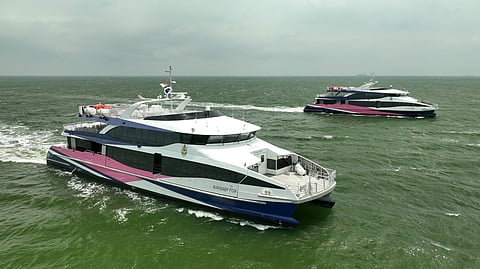

These two new high-capacity aluminium catamaran ferries placed into service in Bermuda were built by Strategic Marine in Singapore to a design by One2Three.
Their innovative Z-bow hulls deliver industry-leading hydrodynamic efficiency and excellent seakeeping while significantly reducing fuel consumption and CO₂ emissions by approximately 25 per cent per passenger mile compared to the older fleet.
These custom-designed catamarans excel in both commuter and tourist shuttle services across Bermuda’s Great Sound, offering increased capacity and modern comfort for residents and cruise visitors alike.

"They constitute the next generation of ferries we have delivered for a client to whom we have provided boats and services for 20 years," One2Three Managing Director Steve Quigley told Baird Maritime. "With a capacity to carry 550 passengers utilising a mix of internal and external seating, it is quite substantial for 40-metre-long ferries.
"The vessels do not feel overcrowded, however, as the passengers are distributed across three decks by utilising the sun deck for seating, which is a fantastic place to take in panoramic views of the Bermudan waters."
Comfortable seating is provided for all passengers with dining tables provided on the onboard kiosk. Full-height windows throughout the passenger spaces provide excellent visibility to all on board so that they can enjoy the Bermudan scenery.
"Designed to service both the commuter and tourist markets, the vessel was optimised to ensure rapid and easy passenger flow through maximising aisle widths and a wide staircase delivering passengers to the bow for boarding," said Quigley. "The bow boarding makes for quicker and easier docking, thereby saving time and cost. Provisions were also made on the foredeck for the storage of bicycles and motorbikes, offering commuters greater flexibility in their travel choices."
The superstructure is a rafted design, joined to the hull through the installation of rubber mounts. These mounts serve to isolate the hull from the noise and vibration produced in the engine room, resulting in a significantly more comfortable and pleasant ride for the passengers and crew.
"Additionally, the Z-bow hull designs benefit from our many years of hull design optimisation, resulting in industry leading efficiency and excellent seakeeping. When compared with the ferries being replaced, the fuel consumption per passenger mile is reduced by approximately 25 per cent with these new ferries, which provides a significant saving on both fuel and emissions while using tried and tested solutions."
"Both Warbaby Fox and JL Cecil Smith were designed and built to meet the evolving needs of Bermuda’s ferry transport network, which is seeing increased ridership, and higher capacity ferries are therefore required to provide efficient services into the next few years," added Hans Randklev, General Manager Commercial at Strategic Marine.
"What is special about these ferries is that they provide this higher capacity while also reducing the fuel consumption per passenger mile without reducing operating speed on conventional diesel propulsion. This means that the overall CAPEX and OPEX costs are low and reliability and vessel availability should be high."
Randklev remarked that passenger comfort and amenity was also high on the agenda, which is why the ferries were built with resiliently mounted superstructures to significantly reduce noise and vibration. The widths of the aisles and staircases are also generous and together with wide passenger doors across the bow, this configuration allows for efficient movement of passengers on board and quick turnarounds at each terminal.
"These builds went smoothly, and the vessels exceeded contract requirements and were delivered to the client on time in Bermuda," said Randklev. "We also completed start-up support and training of the operational crew prior to final hand-over. Personally I think this project is a good example of a successful collaboration between an experienced operator working closely with a leading designer and a dedicated shipyard."
For Quigley, the major challenge from a design perspective was in accommodating 550 passengers on what is a relatively small platform for this number of people while still maintaining vessel performance, operability, safety and aesthetics.
"The fact that these objectives were all met on time and on budget and resulted in the delivery of a pair of such functional and attractive vessels, is testament to the hard work, knowledge and experience of both designer and builder."

The new Bermuda ferries were among the 25 vessels delivered by Strategic Marine to various customers in 10 countries in 2025, and these include vessels serving other industries such as offshore energy.
"Going forward we have a good number of projects in the yard and we also have a healthy pipeline of enquiries that we are working on," Randklev told Baird Maritime. "Our team is stronger than ever so we have plenty of reasons to look forward to the next few years with optimism."
In One2Three's case meanwhile, Quigley said business conditions remain strong despite headwinds caused by the conflict in the Middle East and the impact of US tariffs and US inflation on build costs.
Nonetheless, Quigley believes the ferry industry will remain active, with an increased focus on reducing fuel consumption and a continued move towards cleaner energy technologies.
Randklev also noted this preference for lower-emission propulsion proliferating in the ferry industry.
"There are several technologies being applied in ferries these days including hybrid and fully electric drives and lower-carbon fuels such as methanol and hydrogen. The common denominator for all of these options is that they add weight and cost to the vessel and often the alternative energy is more expensive than traditional diesel fuel.
"For high-speed ferries this is a challenge, and it is why more novel designs such as surface effect ships and foiling vessels that offer reduced resistance and lower energy consumption are making a bit of a comeback. There are successful operational examples of both of these technologies that go back several decades so these are not new, but further refinements have been made. For the right operations, these technologies may make sense, but it is also important to understand their potential drawbacks when compared to conventional catamaran hulls."
Randklev believes that the drive towards emissions reductions will continue and the indicated solutions will likely play a role in this development. However, replacing diesel will probably take longer than expected due to barriers such as cost, availability, power density and weight.
As for the broader Southeast Asian shipbuilding industry, Randklev is optimistic that the future of the industry is bright as capabilities are increased and products are improved.
"Cost pressure is an ongoing concern for us and we constantly work hard to improve our internal efficiency," Randklev told Baird Maritime. "We are also working closely with our suppliers to make sure they can support us with high-quality solutions and products that are fit for purpose and at costs that are sustainable for all parties. As shipbuilding is a cyclical industry we remain focused on being active in several market sectors to keep our yard busy even if there is a slowdown in one or two of these sectors."
Randklev said that, as an aluminium shipbuilder, Strategic Marine has continuously regarded the need to find a balance between high speed and reduced fuel consumption as a key driver impacting shipbuilding.
"Most operators still rely on diesel as their primary energy source as alternatives are still too expensive and in many cases not viable as replacements. We work closely with our designers and equipment suppliers to make our vessels as efficient and as capable as possible while using proven technologies to ensure long-term reliability for our customers.
"Having said that, there are projects where alternative sources of energy make sense and can offer not only emissions reductions, but also cost savings over the vessel's life cycle. This is exciting and offers some hope and direction for energy transition. For us as shipbuilders we try to keep abreast of emerging technologies and to understand when and where these can best be applied to provide meaningful operational improvements."
Randklev added that IMO Tier III emissions regulations now apply in some emission control areas, which may necessitate the installation of selective catalytic reduction (SCR) units.
"SCRs add weight and cost and take up valuable space on board, and for high-speed vessels in particular, the added weight results in higher fuel consumption, which in turn produces more CO2 emissions. So while the units help reduce particulates, they ended up generating additional greenhouse gas emissions, so it will be interesting to see if better solutions will become available and at what rate the current IMO Tier II areas will adopt and change to IMO Tier III."
For a list of the 2025 "Best Of" award winners, please click here.

