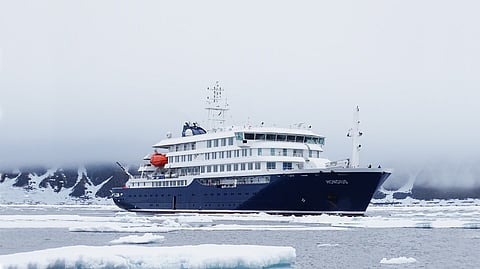


Groups of passengers and crew disembarked from a cruise ship hit by a hantavirus outbreak on Sunday to be evacuated to their respective countries in a process overseen by global health officials and expected to last until Monday.
The passengers, none of whom were showing symptoms of the virus, were taken to Tenerife airport in military buses to be evacuated from the island in government planes sent by their respective countries, government officials said, emphasising that they will have no contact with the public.
The World Health Organisation (WHO) has recommended a 42-day quarantine for all passengers from the boat from Sunday.
Planes for the Spanish and French nationals had departed by 11:30 GMT. Canada, the Netherlands, the UK, Turkey, Ireland, and the United States were listed by Spanish health minister Monica Garcia as the next countries to evacuate their citizens, with the Dutch plane also due to take Germans, Belgians and Greeks.
A plane from Australia which would transport its citizens as well as passengers from New Zealand and other unspecified Asian countries was due to land on Monday and depart by the afternoon, Garcia said.
Hantavirus, which is usually spread by rodents but can in rare cases be transmitted person-to-person, was first detected on May 2, 21 days after the first passenger died, by South African health officials testing a British man who was in intensive care. Two other former passengers have died since.
The luxury cruise ship left for Spain on Wednesday from the coast of Cape Verde after the WHO and European Union asked the country to manage the evacuation of passengers after the hantavirus outbreak was detected.
The agency said the first case may have been infected before boarding, possibly during travel in Argentina and Chile, with later spread likely occurring on the ship.
The WHO said in an update on Friday that eight people no longer on the ship had fallen ill, including the three who died - a Dutch couple and a German national. Of the eight, six are confirmed to have contracted the virus.
WHO chief Tedros Adhanom Ghebreyesus, in Tenerife to oversee the evacuation, said on Sunday that WHO experts were working alongside Spanish health officials to test the passengers.
One Spanish woman, who was suspected of having the virus after sharing a flight with one of the patients who later died, tested negative late on Saturday.
The UK military has parachuted a specialist team onto the remote island of Tristan da Cunha to provide medical support to the second suspected case, a British man who was a passenger on the ship and lives on the island in the South Atlantic.
Four patients remain hospitalised in South Africa, the Netherlands and Switzerland, while a suspected case sent to Germany tested negative.
All passengers on the cruise ship Hondius are considered high-risk contacts as a precautionary measure, Europe's public health agency said late on Saturday as part of its rapid scientific advice, adding that the risk to the general population remains low.
Spain's health ministry said in a report on the ship passing the appropriate health checks: "There are more than 500 cruise ships a year that come from Argentina and Chile, which is home to the virus, and yet an outbreak of this illness has never happened in European territory so the possibility it happens in relation to this ship is remote."
It also said rodents had not been detected aboard the ship.
Passengers will not leave the boat until their allocated evacuation plane has arrived, Spanish officials said.
Thirty crew members will remain on board and sail to the Netherlands where the ship will be disinfected.
(Reporting by Corina Pons, Victoria Waldersee, Leonardo Bennasetto, Miguel Pereira; Writing by Victoria Waldersee; Editing by Aislinn Laing, Helen Popper, Philippa Fletcher)
