VESSEL REVIEW | Starnav Elektra – Brazil's first locally built hybrid platform supplier to support Petrobras' offshore operations
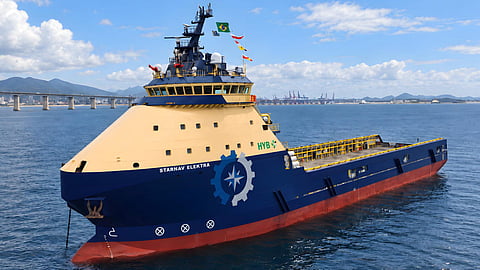
Brazilian offshore vessel operator Starnav Serviços Marítimos has taken delivery of a battery hybrid platform supply vessel (PSV) for service at Petrobras’ offshore installations in Brazilian waters under a long-term charter.
Starnav Elektra was designed in-house by Detroit Brasil and built at the company’s shipyard in Itajaí, Santa Catarina. She is the first hybrid-powered vessel built in Brazil and the first delivery under Petrobras's Programa Mar Aberto fleet renewal initiative.
She was formally named at Pier Mauá in Rio de Janeiro on September 17.
First in a planned series
The PSV belongs to Detroit Brasil's family of vessel designs intended to cut fuel consumption and emissions.
“One of the vessel’s key differentiators is that her hybrid propulsion system is part of a broader energy efficiency strategy rather than an isolated technological feature,” Detroit Brasil told Baird Maritime. “The design incorporates complementary solutions intended to optimise overall vessel performance including hull efficiency, anti-fouling technology and integrated energy management.”
The builder also said the vessel has a high level of local content. It added that she marks the resumption of Brazilian-built offshore support vessel construction after nearly a decade of limited activity in that segment.
“The project brief was to deliver a modern offshore support vessel capable of meeting demanding operational requirements while improving energy efficiency, environmental performance, safety and onboard comfort. From the shipyard’s perspective, the challenge was to translate these objectives into an integrated vessel design that would maintain the reliability, availability and operational flexibility expected by the offshore industry.”
Particular emphasis was placed on optimising fuel consumption and emissions without compromising the vessel’s ability to perform its operational duties. Detroit said this required consideration of the propulsion architecture, energy management, hull performance and the integration of onboard systems as part of a coherent design philosophy.
“Another important objective was to maximize the contribution of Brazilian engineering, manufacturing and suppliers wherever technically and commercially feasible. The result is a vessel that combines a high level of local content with advanced technology and a design approach aligned with the industry’s growing focus on operational efficiency and environmental responsibility.”
Starnav Elektra has an LOA of 92.1 metres (302 feet), a beam of 20 metres (66 feet), and a depth of eight metres (26 feet). Her deadweight is 5,500 and her gross tonnage is 4,985. She is classed by ABS with the ESS-LiBATTERY, HYBRID and SUSTAIN-1 notations and is DP2-capable.
The PSV has a total cargo deck area of approximately 1,000 square metres (11,000 square feet). She can carry both dry and liquid bulk cargoes, “providing operational flexibility to meet the different logistical demands of offshore support activities,” said Detroit Brasil.
There is also accommodation available for up to 42 people.
Working deck laid out for enhanced efficiency, capacity and safety

The builder said the PSV’s deck arrangement was developed around Petrobras's latest operational demands, "rather than simply adopting a conventional offshore support vessel layout". Equipment positions and working areas were set to ease cargo handling, crew circulation, inspection access, and routine maintenance over the vessel's service life.
“The overall approach was to develop a practical and efficient deck arrangement that meets the owner’s operational expectations while supporting safe working practices, equipment availability and long-term maintainability,” the builder said.
Equipped with emissions monitoring and reduction systems
The vessel has FiFi1 capability. She is also fitted with an ultrasonic anti-fouling system and a monitoring system that records fuel consumption and greenhouse gas emissions. The ultrasonic system complements the vessel’s anti-fouling capability by helping control marine organism accumulation on treated surfaces, while the exhaust catalysts contribute to reducing NOx emissions.
The onboard monitoring system meanwhile provides information to support the assessment of fuel consumption and greenhouse gas emissions, helping the operator evaluate environmental performance and identify opportunities for further efficiency improvements.
“Starnav Elektra features a hybrid propulsion architecture designed to integrate a battery bank and a conventional diesel electrical power generation plant, with electrical power management and energy storage,” the builder told Baird Maritime. “The system is intended to coordinate the available energy sources with the vessel's propulsion and electrical demands, allowing energy production and consumption to be managed according to the operating condition.
“This approach provides flexibility across different operating modes and creates opportunities to improve the efficiency of the overall power plant, particularly when the vessel's power demand varies during offshore operations.”
Power comes from four MTU 16V4000M33S engines, each rated at 2,080 kW (2,790 hp) at 1,800 rpm, driving 1,825kW gensets. The engines meet IMO Tier III standards through Hug Engineering selective catalytic reduction systems.
Manoeuvring is via two Schottel 2,500kW azimuthing thrusters. These are supplemented by three 1,200kW bow thrusters. The vessel’s service speed is 12 knots.
A 1,322kWh lithium iron phosphate battery bank was supplied by WEG and weighs 38 tonnes. It sits on the main deck aft of the wheelhouse rather than in the hull, a location meant to make maintenance access easier and lower risk. The bank is sized to meet Petrobras's requirement for the vessel to remain in position using battery power for up to 20 minutes if one engine fails.
Detroit Brasil has described two further uses for the batteries. In peak shaving, they cover demand peaks so the engines stay within their preferred range. As spinning reserve, they allow the vessel to run with fewer generators online. The electrical plant can also operate in open or closed bus configuration.
WEG also developed a fully customised electrical, automation and monitoring system for the vessel.
“For Detroit Brasil, this approach reinforces a key principle behind the Starnav Elektra: advanced vessel technology is most effective when it is engineered as an integrated solution, tailored to the vessel’s actual operational needs rather than assembled from independent equipment packages,” the builder said.
Hybrid propulsion setup adapted to heavy-duty daily offshore activities
The company remarked the main construction challenge was combining conventional shipyard work with installing and commissioning the hybrid energy system. That meant coordinating cable routing, interface management, equipment deliveries and supplier support within the build schedule.
“One of the main design challenges was integrating hybrid propulsion into a vessel designed to meet the demanding operational profile of the offshore support sector. Hybrid technology requires a coordinated approach to propulsion, electrical power generation, energy storage and power management. These systems must operate together efficiently under different operating conditions while maintaining the required levels of safety, reliability and redundancy.”
Another challenge was to optimise the vessel as a complete system. Detroit said the benefits of hybrid propulsion depend not only on the propulsion equipment itself, but also on hull characteristics, operating profiles, auxiliary loads and the way energy is generated and consumed onboard. The engineering team therefore had to consider the interaction between these elements from the design stage, ensuring that technological improvements supported the vessel’s operational requirements.
“The project also required close coordination between the shipyard’s engineering disciplines, equipment manufacturers, suppliers and classification stakeholders to ensure that the selected solutions could be integrated into a practical, buildable and maintainable vessel.”
Another important consideration was coordinating equipment deliveries, technical documentation and supplier support within the construction schedule. The builder said these activities are particularly important when several specialised systems must be integrated and tested before delivery.
“For Detroit, the project also represented an opportunity to further develop its production processes and technical expertise in hybrid vessel construction, building on its established capabilities in offshore support vessel engineering and manufacturing.
“The experience demonstrated the importance of early engineering coordination, effective interface management and close collaboration between the shipyard, owner, suppliers and classification society throughout construction and commissioning,” Detroit Brasil told Baird Maritime.
In the builder’s view, the work on Starnav Elektra reinforced the importance of approaching energy efficiency as a whole-vessel engineering objective rather than focusing on a single piece of equipment.
“The performance of a hybrid vessel depends on the coordinated operation of its propulsion system, power generation, energy storage, control systems and hydrodynamic design. These elements must be considered together from the earliest stages of development.”
The project also highlighted the value of involving equipment manufacturers and technical partners early in the design process. Early coordination helps identify interfaces, optimise equipment arrangements, reduce integration risks, and improve the efficiency of construction and commissioning.
“Another important lesson concerns the role of local engineering and the Brazilian supply chain. Developing domestic expertise in advanced vessel technologies strengthens the shipyard’s ability to deliver future projects and provides a foundation for continuous improvement.
“These lessons will support the further development of the Detroit [line of energy-efficient vessels], allowing the shipyard to apply the knowledge gained to future vessels and continue improving efficiency, reliability and environmental performance.”
Starnav Elektra is the first of up to 10 battery hybrid vessels planned for the operator, comprising six PSVs and four oil spill response vessels. The series are scheduled to enter service between 2026 and 2028.
