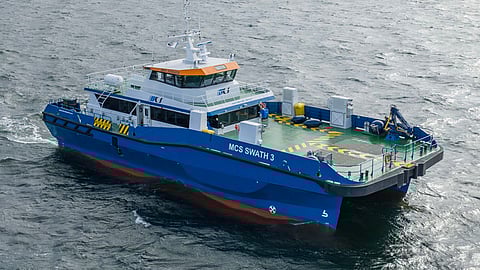


This first vessel in a new series of high-performance crewboats by Finnish builder Työvene and designed by Ad Hoc Marine Designs excels in the demanding North Sea environment for offshore wind farm personnel transfers.
Distinctive features include its advanced SWATH hull, which dramatically reduces vertical motion and acceleration in rough seas through minimal waterplane area, a modified bow for enhanced damping, and a zero-heave motion control system that cuts vertical displacement by over 70 per cent.
This ensures technicians arrive rested, eliminates seasickness, and enables safer, more reliable transfers with "stick like glue" stability against towers. It handles a maximum significant wave height of three metres, allowing up to 90 extra operational days annually compared to conventional crewboats.
Built for high availability and economic operation, MCS SWATH 3 supports renewable energy expansion with superior comfort, efficiency, and seakeeping.

"She is an evolution of the previous MCS SWATH 1 and 2," John Kecsmar, co-founder of Ad Hoc Marine Designs, told Baird Maritime. "MCS SWATH 1 proved that SWATH vessels had finally come of age and dispelled a number of myths, notably being sensitive to weight, slow, expensive, having too deep a draught, etc. MCS SWATH 2 pushed this further by maintaining the same platform, but increasing the payload range from 20 tonnes up to 40 tonnes, though this made it slower than MCS SWATH 1, i.e.., same size but heavier, resulting in greater drag."
Kecsmar said, however, that MCS SWATH 3 used a well-known hydrodynamic technique to reduce resistance, increasing the waterline length. With each evolution of these SWATH vessels for the owner, the operational profile increased, thus saving on operational costs in terms of engine power and fuel consumption.
"So by using the simple law of hydrodynamics in scaling up the vessel, we have been able to maintain the same operational profile as on MCS SWATH 2 but on a larger platform, with a 20 per cent lower power requirement but the same speed."
The concomitant effect of increasing the size is an even greater improvement in seakeeping, and it pushed the operational profile from suitability in wave heights of up to 2.5 metres, thus allowing the vessel to operate in three-metre wave heights with minimal motions, according to Kecsmar.
Nils P. Olschner, Director of Sales and Business Development at Työvene, added that MCS SWATH 3 is unique for having, "an extremely seaworthy type of hull that drastically reduces motions of the vessel," if designed and built the right way.
"Vertical accelerations can be in the range half of the values that you would measure on board catamarans," Olschner remarked. "That in return means more comfort, less seasickness, longer operability in offshore wind farms due to higher access limits, and higher speeds in higher seas compared to conventional crewboats."
Olschner explained that Työvene's task in the project was to accommodate the necessary changes resulting from crews' operational experiences and to further improve the performance of the vessel. For example, the company optimised accessibility to the technical compartments to enable easier maintenance by the crew, and it developed a hybrid-ready propulsion plant with already built-in PTIs for future propulsion alternatives for the benefit of the charterer.
The builder also increased comfort and safety on board for the service technicians who will be riding the vessel regularly.
"The first operational sailings indicate that MCS SWATH 3 is able to outperform her competitors and is going to operate the extra 100 days or even more in North Sea that have been reported for her older but smaller sisters."
Olschner said that although Työvene has had years of experience in building vessels with more traditional hull forms such as monohulls and catamarans, a SWATH design posed a challenge that required greater knowledge and attention during the actual build process.
"Probably, the sensitivity of SWATH towards weight and centre of gravity is known to most in the industry, but building a SWATH hull within weight and time constraints while ensuring the necessary quality is another thing altogether," he told Baird Maritime. "After all, we cannot sell vessels that claim to be (and are) capable of operating in tougher conditions than any other competitor but provide only standard quality in terms of workmanship and equipment. To that extent, we have learned a lot as expected, and we are now looking forward to more SWATH newbuilds for offshore wind farm support but also other applications where safe transits, transfers, and working in high seas are essential."
For Kecsmar, the challenge lay mainly in the placement of the engines.
"The main lesson we learned is that IMO Tier III engines have very large SCR units and urea tanks, which is not so difficult to find space for on a conventional vessel. However, on a SWATH with very limited space, doing so was rather tricky. Additionally, a ballast water management system is almost impossible to find for a vessel with such a low volume usage that is also IMO-compliant."
Ensuring MCS SWATH 3's compliance with IMO emissions standards through these design approaches was in line with a growing shift towards hybrid and fully electric propulsion, which Kecsmar identified as a trend currently impacting naval architecture.
"Several years ago, there was a shift away from internal combustion engines (ICEs) to hybrid or fully electric propulsion. There was Operation Zero (OZ), which the UK Government initiated to restrict ICE usage and to ensure all vessels operating in the North Sea must have zero carbon emissions by 2025.
"Those initiatives sadly did not bear fruit despite off-the-shelf solutions being available out there, though they seem to be slowly coming back into the conversation again. However, without legislation to enforce such a change, like OZ, it will merely be a topic of decision."
In Olschner's view, meanwhile, one of the most important factors currently shaping shipbuilding is the global push for greater energy efficiency and lower emissions, these being driven by IMO regulations and regional frameworks in Europe. Shipowners therefore demand vessels that combine high operational performance with reduced environmental impact.
"At the same time, there is strong demand for high-performance vessels capable of operating safely in challenging sea conditions, particularly in offshore environments where reliability and crew comfort are essential. MCS SWATH 3, with her hybrid-ready propulsion, reflects these trends well.
"Thanks to its SWATH design, the vessel offers outstanding seakeeping and significantly reduced motions compared to conventional hull forms, enabling safer and more efficient offshore operations while maintaining a strong focus on operational efficiency."
The delivery of MCS SWATH 3 was just one of the highlights of 2025 for Työvene. As Olschner explained, the company was able to increase both its turnover and profitability during the previous year.
"We currently have a very strong orderbook and there will be significant growth in coming years," he told Baird Maritime. "Our confidence in the market and its potential can also be seen in our acquisition of our new, additional shipyard in Olkiluoto, where we are already building a series of two hybrid battery-electric ferries."
Olschner believes there is also potential in the offshore vessel industry, as he expects it will experience continued growth with the expansion of the offshore wind sector.
"This will increase demand for specialised service vessels capable of operating safely and efficiently in demanding offshore environments. At the same time, the industry will continue to focus on lower emissions, improved energy efficiency, and more advanced vessel technologies. Hybrid propulsion systems and optimised hull designs will become increasingly important as operators look to reduce operational costs and environmental impact."
Olschner said another key trend will be the demand for highly capable and reliable vessels that can operate in rougher sea states and extend operational windows.
"Offshore wind farms see more and more SOV concepts supported by more capable crewboats. These capabilities can either be achieved through pure size and weight or by advanced designs like that of MCS SWATH 3. SWATH vessels are particularly well suited for these requirements, as they provide superior stability and comfort, which is essential for offshore survey, support, and maintenance operations."
Kecsmar meanwhile remarked that the offshore industry will be driven by a desire by operators to achieve a lower carbon footprint.
"The issue is, as always, going to be the source of energy to power engines," he told Baird Maritime. "There is a range of options from hydrogen to methanol, ammonia, bio-diesel, etc, and black, grey, green or blue versions [of these fuels] only complicate matters."
The real issue therefore will be determining a viable replacement for diesel. Kecsmar explained that the energy density of these options is only around five per cent up to around 40 per cent that of diesel, and there are also the difficulties of acquiring infrastructure for using the alternative.
"It is hard to see where the industry will go, hence the current stalemate," said Kecsmar.
Even with what Kecsmar regarded as another challenge facing the global offshore industry, Olschner remarked that within their own collective geographical coverage, the Finnish and Scandinavian workboat industries are well positioned for the coming years, particularly due to their strong reputation for high-quality, specialised vessels designed for demanding environments.
"With extensive experience in operating in harsh weather conditions and cold climates, shipyards in the region will continue to play an important role in developing advanced workboat solutions," said Olschner.
"One key trend will be the growing need for highly specialized vessels with excellent seakeeping and operational reliability. Scandinavian shipyards have traditionally focused on this segment, and designs such as SWATH vessels demonstrate how innovative concepts can further improve safety, comfort, and operational efficiency in challenging sea conditions."
For a list of the 2025 "Best Of" award winners, please click here.

