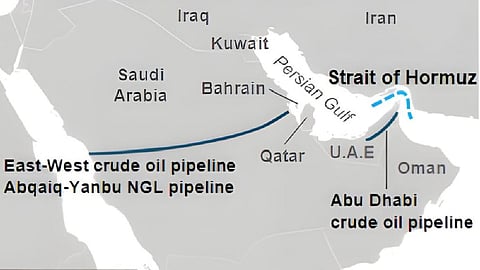


The UAE's new crude pipeline bypassing the Strait of Hormuz is about 50 per cent complete, the head of ADNOC said on Wednesday, adding that global oil flows may take at least four months to recover to 80 per cent of pre-conflict levels after the Iran war ends.
Tehran has largely kept the waterway critical for global oil and gas supplies shut to all ships other than its own since US-Israeli strikes on February 28, sending energy prices and inflation surging and fanning fears of an economic downturn.
The Abu Dhabi Media Office revealed the existence of the new West-East Pipeline project last week, saying Crown Prince Sheikh Khaled bin Mohamed bin Zayed directed state-owned oil giant ADNOC to fast-track its construction in order to double export capacity via the port of Fujairah by 2027.
"Today, it's already almost 50 per cent complete, and we are accelerating its delivery towards 2027," Sultan Al Jaber said during a live-streamed Atlantic Council event, among his most extensive public remarks since the war began.
"Right now, too much of the world's energy still moves through too few choke points. That is exactly why the UAE made the decision more than a decade ago to invest in infrastructure that bypasses the Strait of Hormuz."
The existing Abu Dhabi Crude Oil Pipeline (ADCOP), which carries up to 1.8 million barrels per day, has proved crucial as the UAE seeks to maximise exports from the Gulf of Oman coast just outside the strait.
Iran, which has attacked vessels to assert control over the strait, has expanded its definition of the waterway to include the UAE's Gulf of Oman coastline. The US has imposed its own blockade on Iranian ports and attempted an aborted operation to reopen the chokepoint.
Gulf Arab countries, which host US military bases, have come under attack during the conflict, even since the fragile ceasefire that began on April 8.
The UAE was targeted by more than 3,000 missiles and drones aimed at civilian infrastructure, including ADNOC's, where damage assessment is ongoing and full operational capacity could take weeks to months in some cases, Al Jaber said.
"The UAE was attacked for its model of development," he said.
Even if the conflict ended tomorrow, Al Jaber warned that pre-conflict flows through the strait would not return fully before the first or second quarter of 2027.
"Once you accept that a single country can hold the world's most important waterway hostage, freedom of navigation as we know it is just finished," he said.
"If we don't defend this principle today, we will spend the next decade defending against the consequences."
The accelerated pipeline timeline follows the UAE's withdrawal effective May 1 from the de facto Saudi-led Organisation of the Petroleum Exporting Countries (OPEC), freeing it from output quotas.
The exit was a "sovereign, strategic decision" driven by a global need for more energy, Al Jaber said, stressing it was, "not aimed at anyone," and, "not intended to rupture any relationship".
He warned the global sector remains dangerously under-invested, noting current upstream investment of around $400 billion a year barely offsets natural decline rates. Global spare crude capacity, currently around three million bpd, needs to be closer to five million bpd, he added.
Looking forward, AI will strain global grids and the world is underestimating how energy-intensive the revolution will be, Al Jaber said.
"In many ways, the AI race is an electron race," he said, noting that the speed of AI-driven decision-making can be the difference between continuity and disruption during a crisis.
Al Jaber reiterated the UAE's commitment to investing heavily in the US, adding ADNOC, its international arm XRG and renewables investor Masdar, where Al Jaber is chairman, already have investments worth $85 billion across 19 states.
The UAE and the United States are not just trading partners. We are co-investors in the economy of the next century," he said.
(Reporting by Yousef Saba in Dubai and Ahmad Ghaddar in London; Editing by Andrew Heavens, Tomasz Janowski and Alexander Smith)
