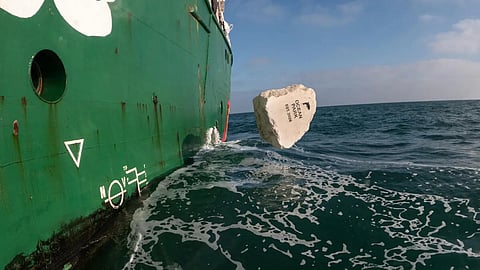
German energy company RWE is investigating the implications of nine boulders placed by attention-seeking environmental activist group Greenpeace within the array boundary of the Vanguard East offshore wind farm off Norfolk in eastern England.
Offshore construction on the project is scheduled to begin in early 2027.
A spokesman for RWE said that the company has had, "constructive communication with Greenpeace," and that the implications of the placement are being investigated.
No construction delay has been confirmed.
The Greenpeace vessel Arctic Sunrise deposited the boulders, each weighing up to two tonnes, on October 31. Greenpeace UK said the barrier closed 116 square kilometres of the Southern North Sea Marine Protected Area to bottom trawling.
"Anyone familiar with offshore wind in the North Sea knows that energy companies routinely move naturally occurring boulders from the seabed before building a wind farm,” said Will McCallum, co-executive director of Greenpeace UK.
McCallum added that some naturally occurring boulders can be ten times heavier than those placed by Greenpeace.
"The suggestion that nine well-publicised rocks pose a genuine obstacle to clean energy is absurd," McCallum claimed.
The 2018 environmental statement for the project conservatively assessed the clearance of up to 16 naturally occurring boulders in Vanguard East, each up to five metres in diameter, with relocated boulders remaining within the site. The Norfolk Vanguard Offshore Wind Farm Order 2022 includes boulder clearance among its authorised seabed preparation activities.
Vanguard West and Vanguard East will have a combined capacity of approximately 2.8 GW and lie 50 to 80 kilometres off the Norfolk coast. RWE and KKR reached financial close on both projects on November 11.
The first Vanguard West foundations are due to be installed in the first half of 2027, followed by Vanguard East, with full commissioning expected in 2030.
Vestas holds orders for 92 turbines for each project. Turbine deliveries for Vanguard East are scheduled to begin in the fourth quarter of 2028.
