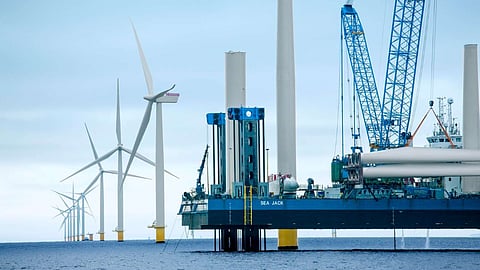


Denmark's Orsted said on Friday it was challenging the US Government's suspension of the lease for its Revolution Wind joint venture and would seek a court injunction against the decision to halt its $5 billion offshore wind project.
The Trump administration suspended leases on December 22 for five large offshore wind projects that are under construction off the US East Coast. The suspension was based on national security concerns, sending shares of offshore wind companies plunging.
The suspension was the latest blow for offshore wind developers that have faced repeated disruptions to their multi-billion-dollar projects under US President Donald Trump.
He has stated he finds wind turbines ugly, costly and inefficient.
Orsted said in a statement on Friday that Revolution Wind was about 87 per cent complete. At the time of the lease suspension order, the project was expected to begin generating power as soon as January 2026.
"Revolution Wind has spent and committed billions of dollars in reliance upon, and has met the requests of, a thorough review process," Orsted said in the statement.
Revolution Wind, a 50-50 joint venture between Orsted and Global Infrastructure Partners’ Skyborn Renewables, filed its complaint with the US District Court for the District of Columbia.
Orsted and Skyborn Renewables in September said they had already spent or committed about $5 billion for Revolution Wind.
Orsted's share price plunged 13 per cent on Monday following the US Government announcement. Squeezed by inflation, higher interest rates, supply chain delays and regulatory headwinds, Orsted last year raised DKK60 billion ($9.4 billion) in a heavily discounted share issue.
The US Department of the Interior has said the decision was the result of complaints by the Pentagon.
The Pentagon claimed the movement of huge turbine blades and highly reflective towers cause radar interference that can make it hard to identify and locate security threats.
Sunrise Wind, a wholly owned subsidiary of Orsted that also received a lease suspension order, continues to evaluate all options to resolve the matter, the company said.
(Reporting by Terje Solsvik; Editing by Tom Hogue)
