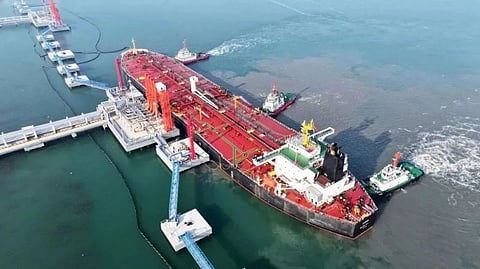


China's independent refiners, Tehran's main oil customers, continue importing Iranian oil despite fresh US pressure, although buying is slowing due to worsening domestic processing margins, trading sources said.
A more definitive threat to Chinese purchases of Iranian oil is the US blockade on Tehran's shipping that began on April 13, which if it remains in place would begin to have an impact on deliveries to China in coming months.
To safeguard fuel supply, Beijing early this month told independent refiners to maintain output or face consequences and issued an off-cycle batch of oil import quotas, measures that traders said effectively encourage buying of Iranian as well as Russian oil, the main feedstock sources for the so-called teapots.
Chinese teapots buy roughly 90 per cent of Iran's oil shipments, importing a record of 1.8 million bpd in March, according to Vortexa Analytics.
Washington warned earlier this month that it could sanction buyers of Iranian crude and imposed sanctions last Friday on Hengli Petrochemical Dalian Refinery, one of China's largest independent plants, for purchasing Iranian oil, which Hengli denied.
"The sanctions will complicate refinery operations and may prompt caution among Asian petrochemical buyers, tightening regional supply, but they will not materially shift Chinese refinery buying patterns as long as Iranian supply remains available," consultancy Energy Aspects wrote a Monday note.
However, gross domestic processing margins are estimated by analysts at minus CNY530 ($77.50) per tonne, a one-year low, according to Chinese consultancy SCI, as government-regulated fuel prices lag sharp gains in crude costs due to the Iran war.
Traders familiar with Iranian oil flows said recent transactions have been scarce but Iranian Light was last assessed at parity to a small premium to benchmark ICE Brent on ex-storage basis, in line with last month when it flipped from discount to premium for the first time, eroding demand.
Shandong province, where China's teapots are clustered, continued to receive Iranian oil after a 30-day US sanctions waiver saw a few cargoes diverted to India. The waiver lapsed on April 19.
Among recent discharges, Aframax tanker Tianma offloaded over the weekend into China's Dongying port and the Gracep, a very large crude oil carrier (VLCC), delivered a partial cargo to a terminal in Qingdao on April 21, according to Vortexa.
Tracking Iranian oil has become increasingly difficult as so-called shadow fleet ships use more fake vessel names to mask their voyages.
Kpler data showed VLCC Hauncayo carrying two million barrels of Iranian oil arrived at China's Yantai on Monday. The cargo initially loaded from Iran's Kharg Island and was transferred twice to another ship en route, it showed.
Another three vessels with Iranian oil are slated to arrive in Shandong this week, and nine tankers will arrive May 1-8, Kpler's provisional data showed.
China defends its trade with Iran as legitimate and has repeatedly said it opposes "illegal" unilateral sanctions.
However, Iranian oil delivered to China has long been branded as Malaysian, and more recently Indonesian, and trades in a tight loop, is settled in Chinese currency and involves a chain of difficult-to-track intermediaries, according to refinery sources and traders involved in the business.
Kpler estimates that 155 million Iranian barrels are in transit outside the US blockade zone, while Vortexa puts the number at 140 million barrels, at least, enough to last more than two months of China's Iranian oil purchases at current pace.
(Reporting by Chen Aizhu and Siyi Liu in Singapore; Additional reporting by Ju-min Park in Beijing; Editing by Tony Munroe and Raju Gopalakrishnan)
