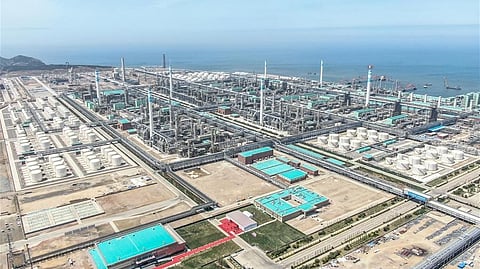


China's Hengli Group, whose refinery unit was sanctioned by the US, adjusted the shareholding structure of its Singapore-based trading arm to shift control to a Chinese local government entity, sources familiar with the matter said.
The Singapore unit, Hengli Petrochemical International, is now 95 per cent-owned by Dalian Changxing International Trade, with Hengli Petrochemical Dalian Refinery holding five per cent, the sources said, citing a shareholding document they received from the firm.
Previously, the Singapore unit was fully owned by Hengli Petrochemical Dalian Refinery. Dalian Changxing International Trade is owned by a local Chinese government entity, according to Qichacha, a corporate information database.
A Hengli spokesperson did not immediately respond to a request for comment.
Several trading executives said they were sceptical that the move would insulate the Singapore unit from the wariness of its counterparties given its ownership when the US measure was unveiled on Friday.
"Banks and counterparties will make their own calls on compliance and err on the cautious side," one source said.
Two Western-based shipbrokers and two derivatives brokers told Reuters that they are unable to conduct deals with the Singapore unit following the sanctions announcement.
All of the sources declined to be named given the sensitivity of the matter.
Hengli's Singapore unit focuses mainly on derivatives trading for crude oil and petrochemicals, with limited physical trade of refined fuel, traders said.
On Friday, the US Treasury Department unveiled sanctions on Hengli Petrochemical Dalian Refinery, a unit of Hengli Petrochemical, saying it had bought billions of dollars worth of Iranian oil.
Shanghai-listed Hengli Petrochemical denied having trade dealings with Iran.
The private refiner, which operates a 400,000 barrel-per-day integrated crude-to-chemicals site in the northeastern city of Dalian, exported on average at least 50,000 tonnes per month of petrochemicals last year, Kpler ship-tracking data showed.
Last year, another large Chinese refiner with a Singapore presence, Shandong Yulong Petrochemical, saw non-Russian suppliers, foreign customers, banks and vendors stop doing business with it after it came under sanctions from Britain and the European Union for dealing in Russian oil.
(Reporting by Trixie Yap, Chen Aizhu and Siyi Liu; Writing by Tony Munroe; Editing by Kim Coghill and Thomas Derpinghaus)
