VESSEL REVIEW | New Haijing 1 – Chinese hopper dredger for channel maintenance and offshore sand extraction
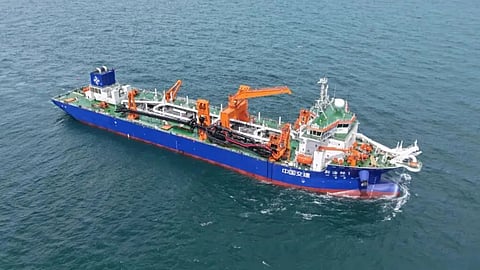
CCCC Shanghai Dredging took delivery of the trailing suction hopper dredger (TSHD) New Haijing 1 (新海鲸1; Xinhaijing 1) from Shanghai Zhenhua Heavy Industries (ZPMC) at the shipbuilder's Qidong yard in Jiangsu province on October 23.
The vessel was designed by China State Shipbuilding Corporation's 708 Research Institute. The general contractor was the National Engineering Research Centre for Dredging Technology and Equipment.
She will be operated by Zhonggang Dredging, a subsidiary of CCCC Shanghai Dredging, and is classed by the China Classification Society.
The owner has positioned the TSHD primarily for offshore sand extraction, with dredging of coastal deepwater port channels as a secondary role. She will also undertake land reclamation and coastal protection work.
Redundant dredging layout for minimal service interruptions

"The existing hopper dredger fleet can no longer fully meet these requirements in terms of dredging depth, hopper capacity and offshore operating capability," said Gu Yong, Deputy General Manager and Chief Engineer of CCCC Shanghai Dredging.
New Haijing 1 has an LOA of 180 metres (590 feet), a length between perpendiculars of 166.5 metres (546.3 feet), a moulded beam of 36 metres (120 feet), a moulded depth of 17.2 metres (56.4 feet), and a draught of 10.4 metres (34.1 feet).
Gross tonnage is 31,477, deadweight is 32,199, and total hopper capacity is 27,929 cubic metres (986,300 cubic feet).
The vessel is the first extra-large TSHD in China to house its two inboard dredge pumps in distinct compartments. One pump room is positioned ahead of the hopper with the other behind it rather than both being concentrated in a single pump room.
According to the project team, the layout reduces pipe resistance and improves longitudinal weight balance. It also adds redundancy, because a failure in one pump compartment does not stop the entire dredging operation.
The dredger can work at staged depths from 16 to 115 metres (52 to 377 feet), with a maximum dredging depth of 120 metres (394 feet). These depths are achieved by running the two submerged pumps in parallel or by running a submerged pump in series with an inboard pump.
The forward pump arrangement is combined with twin bow discharge for spraying and pumping ashore.
"Through an innovative fluid dynamic layout, the vessel effectively addresses the pipe resistance and centre of gravity balance problems faced by extra-large vessels under extreme operating conditions, substantially improving vessel stability and hopper-emptying efficiency under different loading conditions," said ZPMC Qidong Deputy General Manager Xu Biao.
A high-throughput draghead was developed for the project for use in both shallow and deep water. Other purpose-built equipment includes a lightweight suction arm system for 120-metre dredging and hopper loading and overflow gear.
Gu said more than 110 domestic suppliers were involved in the programme.
Low-emission propulsion and electronics suite allowing limited required manpower
Propulsion is provided by two CWEC (Shanghai) W9L46F main engines, each rated at 10,800 kW (14,500 hp) at 600 rpm. The engines drive twin propellers in a one-driving-two compound arrangement. Two 1,500kW generators supply auxiliary power.
The hull has a bulbous bow and twin stern fins, and the vessel has a speed of 15.2 knots.
The main and auxiliary engines are fitted with selective catalytic reduction systems to meet IMO Tier III requirements. ZPMC said the vessel achieves approximately 30 per cent greater efficiency in dredging and cuts carbon emissions by more than 20 per cent compared with conventional dredgers of the same type.
An integrated monitoring and management platform combines dredging and navigation control. It provides one-touch dredging, dumping and pump-ashore functions, and unmanned dredging under typical operating conditions.
A separate "digital sentinel" system uses AI vision and lidar to detect smoke, fire, fluid leaks and abnormal personnel activity. The project team said this system’s recognition accuracy as above 95 per cent.
The vessel's class notations include DP-1, AUT-0 and Ice Class B.
The keel of New Haijing 1 was laid in September 2025, and the vessel was launched on March 6, 2026. Sea trials in the East China Sea concluded on September 21.