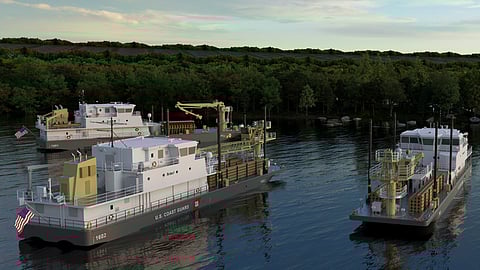

The US Army Corps of Engineers’ (USACE) Jacksonville District has begun mechanically dredging the US Coast Guard boat basin in St Petersburg, Florida.
The work aims to remove sediment restricting vessel movements, particularly at low tide. It will prepare the facility for a new inland construction tender (WLIC) under the coast guard’s waterways commerce cutter (WCC) programme.
The WLIC will replace the construction tender USCGC Vise and have a significantly greater draught, according to Captain Courtney Sergent, commanding officer of Coast Guard Sector St Petersburg.
The dredging will also give larger coast guard vessels access to the station’s southern seawall and allow them to berth nearer the federal channel. Steve Klemme, technical support branch chief with USACE’s South Florida Operations Office, said this will improve the coast guard’s ability to respond to emergencies.
Operators are mechanically excavating the accumulated sediment, which truck drivers are hauling off-site.
Jacksonville District Project Engineer Keijo Hardin said the engineering work involved determining how much material needed to be removed, the excavation boundaries, and where to take the dredged fill. A recent survey was used to update the project, with excavation limits established by the permit.
“We follow the environmental requirements in the permit and engineering requirements, while confirming that the plans still meet the coast guard’s objective,” Hardin said.
The coast guard is also pursuing a separate waterfront recapitalisation programme at St Petersburg. An environmental-assessment notice issued in April described proposed improvements to moorings and facilities to accommodate cutters, including fast response cutters and a WCC.
The coast guard announced a US$60 million contract in August for waterfront repairs and improvements, including work to address Hurricane Helene damage. It expects that project to be completed in summer 2028.
The WCC programme is intended to replace the coast guard’s existing inland tender fleet. The service plans to acquire three inland buoy tenders, 11 WLICs, and 16 river buoy tenders.
In September 2025, the coast guard said the legacy fleet’s average vessel age was nearly 60 years.
Construction had started on the second WLIC, the third WCC overall, by January 2026. The coast guard expects the first WLIC, ordered in June 2025, to be completed in 2027.

